Top 10 Identity and Access Management Tools

The Apono Team
January 14, 2026
As cloud environments sprawl and engineering teams scale, the number of identities you manage has exploded. It’s no longer just employees and contractors; CI/CD pipelines, service accounts, API tokens, and AI-powered agents are all asking for access to production systems and sensitive data.
It’s no shock that identity has become a top-line priority for security and platform leaders. 78% of organizations plan to ramp up spending on identity and access management tools to ease concerns over identity-based attacks that lead to phishing and lateral movement. The challenge in choosing an IAM tool is finding one with the capability to scale with your cloud footprint.
What are identity and access management tools?
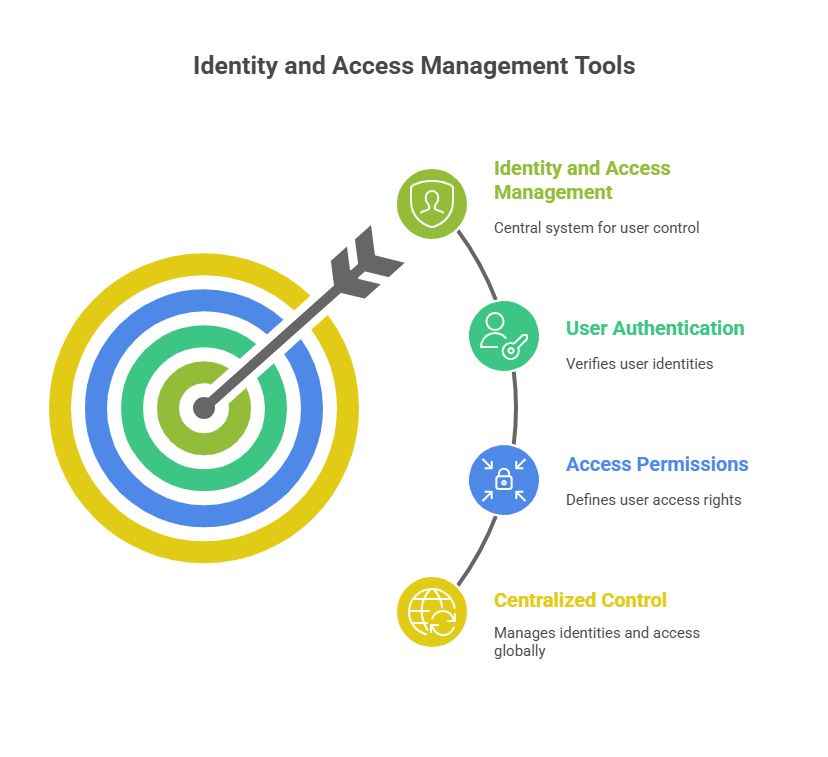
Identity and access management (IAM) tools help you answer two core questions: Who is this?” and “What are they allowed to do?”
IAM tools verify identities through authentication methods such as SSO and MFA, then enforce fine-grained permissions across your cloud providers, infrastructure, and SaaS applications. Rather than letting each system manage its own users and permissions, IAM tools centralize all identity data and access workflows, allowing DevOps and security teams to apply consistent, least-privilege controls.
When people say “identity and access management tools,” they’re usually talking about a whole stack. Not just classic IAM platforms, but also privileged access management (PAM), Just-in-Time (JIT) access orchestration, and secret scanning tools. JIT in particular has become a critical extension of modern IAM strategies.
Cloud-native environments are flooded with non-human identities (NHIs) like service accounts, workloads, and bots, each tied to secrets such as API keys and certificates.
This proliferation means IAM tools now need to govern both human and non-human access with the same rigor to avoid silent, large-scale over-permissioning. A recent State of Secrets Sprawl analysis highlighted that as NHIs multiply, so do the secrets tied to them. Traditional, reactive secrets management simply isn’t enough in automated, cloud-native environments.
Types of Identity and Access Management Tools
Modern IAM spans several categories, and many solutions overlap. Here are the core types engineering and security teams rely on:
- Cloud-native IAM (AWS, Azure, GCP): The built-in controls you use to manage roles, policies, and permissions directly in your cloud accounts.
- JIT and time-bound access platforms: Hand out temporary, scoped access only when it’s needed, so you can actually enforce least privilege across infra and SaaS.
- Machine identity & secrets management: Systems that keep API keys, tokens, certificates, and other credentials for human and non-human identities safe.
- PAM: Platforms that control and log elevated access, increasingly leaning on JIT so admins don’t carry standing privileges.
- Authentication tools (SSO, MFA, passwordless): Services that prove who someone is but don’t decide what that identity can do after they’re signed in.
- Access governance & authorization platforms: Tools that give you visibility and control over entitlements so you can right-size permissions and reduce continuous threat exposure.
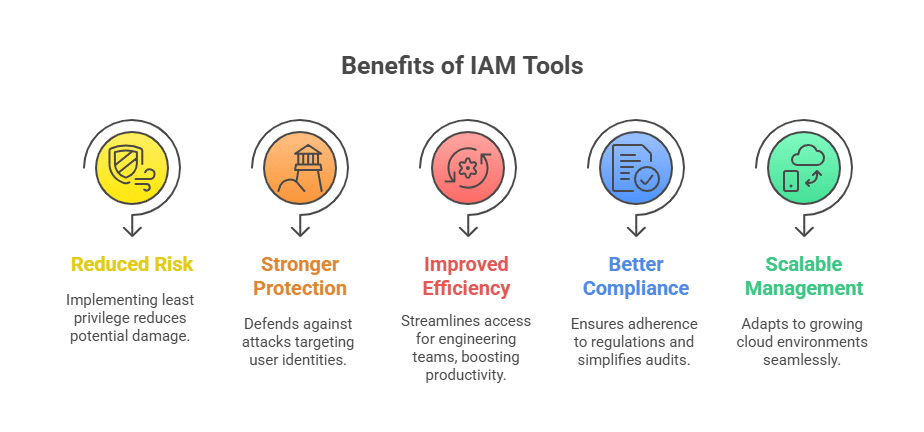
Benefits of Identity and Access Management Tools
Reduced Risk Through Least Privilege
By centralizing roles, policies, and entitlements, IAM tools eliminate excessive permissions, especially among NHIs that accumulate broad access over time. This approach turns Zero Trust from a slideware concept into something your engineers feel day-to-day.
Stronger Protection Against Identity-Based Attacks
When attackers compromise a human or machine identity, they typically exploit misconfigured roles and standing privileges. IAM platforms strengthen defenses with features like real-time access controls that make identity-based intrusions significantly harder to execute.
Improved Operational Efficiency for Engineering Teams
Instead of relying on ad hoc approvals or ticket queues, teams can automate access flows, freeing up DevOps and platform engineers to focus on higher-impact work.
Better Compliance and Audit Readiness
IAM tools offer automated logging and entitlement reviews to reduce audit fatigue and eliminate spreadsheet-driven processes, similar to how efficient laboratory management practices emphasize traceable, well-documented workflows and data integrity.
Scalable Access Management for Cloud-Native Environments
IAM solutions scale policy enforcement and support dynamic access models, such as JIT, ensuring security remains consistent even as you adopt multi-account cloud structures and AI-driven automation.
Key Features to Look For in an Identity and Access Management Tool
- Least-privilege automation: Look for IAM platforms that automate dynamic roles and fine-grained policies, rather than relying on one-off cleanup projects.
- JIT and time-bound access control: Prioritize tools that support time-bound, scoped access and auto-expiring permissions so engineers don’t keep privileges “just in case.”
- NHI security: Features that can discover, right-size, and continuously govern NHIs and their secrets are essential.
- Compliance and audit readiness: Strong options provide centralized logs, reporting features, and access review workflows for repeatable auditing.
- Cloud-native integrations: API-driven, cloud-native solutions embed access control directly into developer workflows (e.g., Slack, Teams, CLI) and manage policies as code as your environment scales.
10 Top Identity and Access Management Tools
1. Omada Identity Cloud
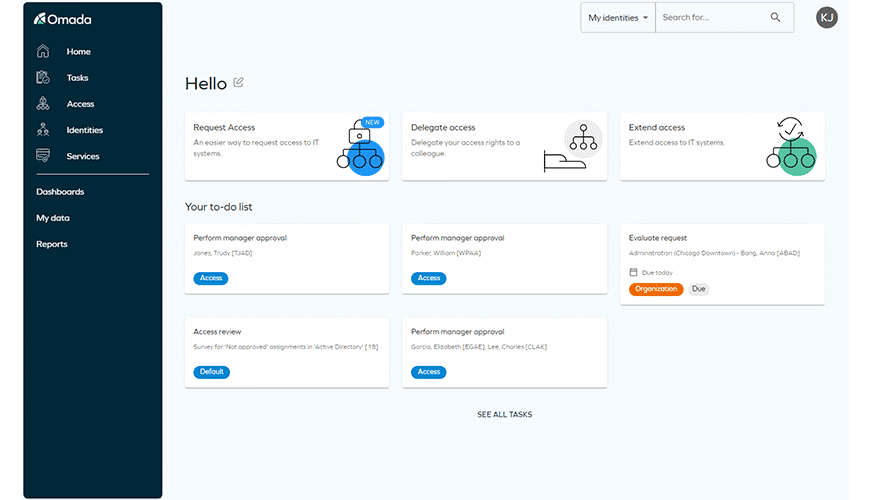
Omada Identity Cloud is a SaaS-delivered Identity Governance and Administration (IGA) platform focused on lifecycle management and access governance. It delivers policy-based controls and offers no-code configuration.
Main Features:
- Risk analytics and AI-driven recommendations to identify anomalous access
- SaaS delivery with standardized implementation program
- Access governance with policy- and role-based controls
Price: By inquiry.
Best for: Deep identity governance and lifecycle management.
Review: “I love the clean interface, simplicity of features and controls, and how quick it is to edit user permissions.”
2. Apono
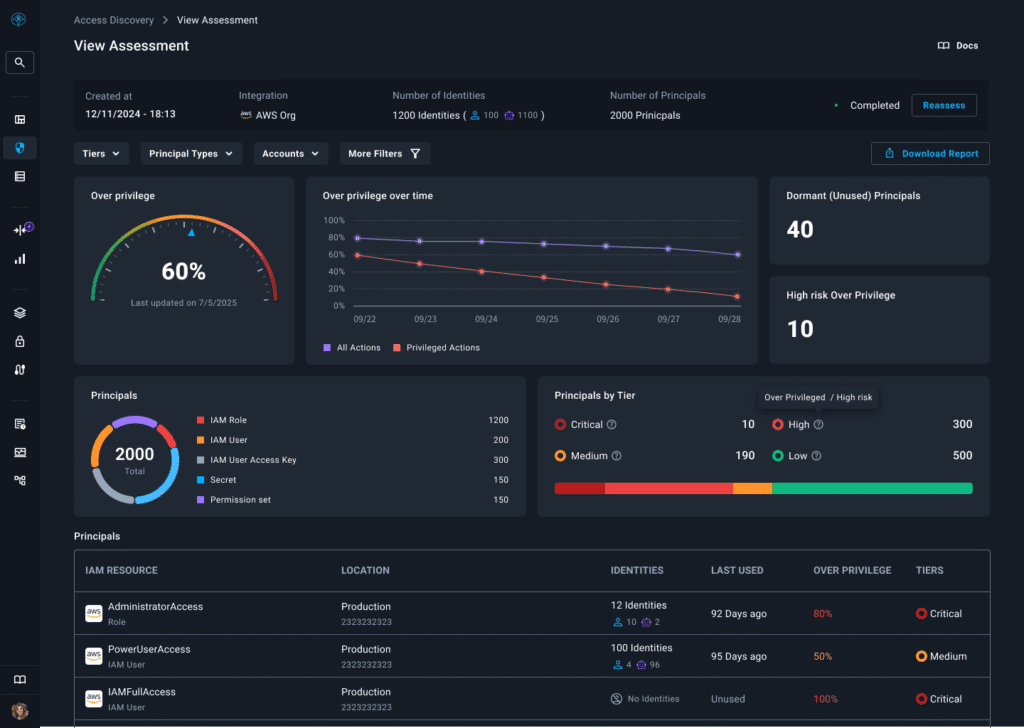
Apono is a cloud-native access management and privileged access platform that automates JIT and Just-Enough-Privilege (JEP) access across your entire stack. Instead of managing static roles or manual tickets, DevOps and platform teams define dynamic access flows that grant granular, time-bound permissions only when needed, then revoke them automatically. Apono is designed to eliminate risky standing permissions for both human and non-human identities without slowing down engineers.
Main Features:
- Enforces automated JIT access policies across cloud providers, databases, and internal tools, drastically reducing standing privileges
- Engineers request granular access directly from Slack, Microsoft Teams, or CLI, with policy-driven approvals
- Pre-configured emergency and on-call access patterns speed up incident response
- Centralized view of who can access what (including NHIs), with automated reports to support compliance audits
Price: Contact the Apono team for a tailored quote.
Best for: Cloud-native engineering and DevOps organizations that need to eliminate standing permissions and automate JIT and JEP access.
Review: “Quick and easy config to integrate access control with a myriad of service providers and data stores. For the admin, it’s pretty straightforward to define and implement access flows. For the requester, all they have to do is ask for it via slack and they get what they need within seconds.”
3. Securden Unified PAM
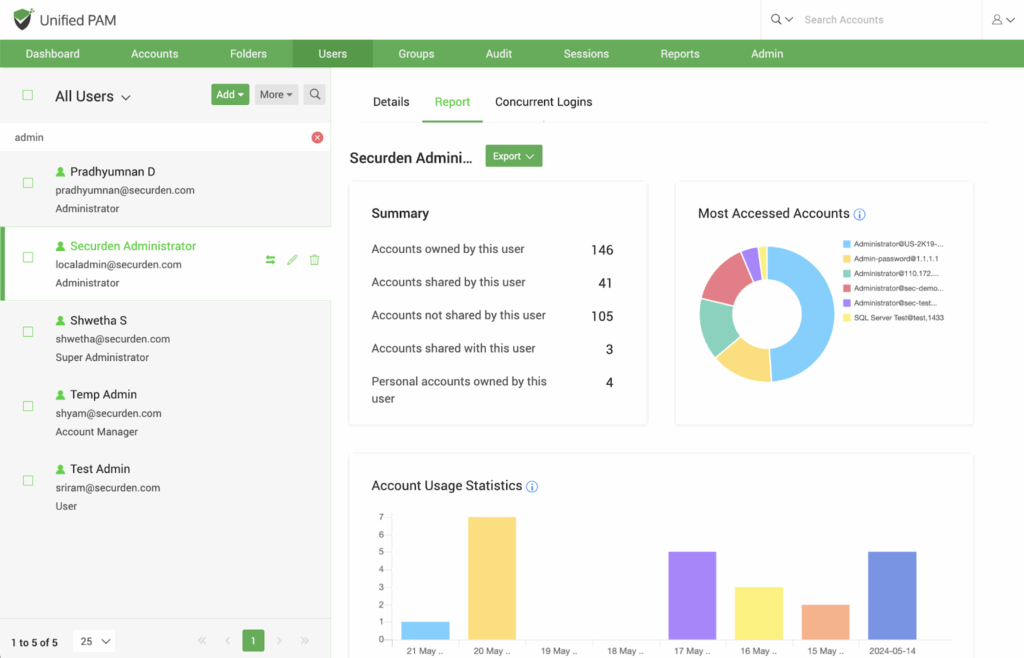
Securden Unified PAM focuses on securing high-risk accounts and keys across servers, databases, network devices, and SaaS. The platform supports on-prem and cloud deployments, making it flexible for hybrid environments.
Main Features:
- Centralized vault for privileged account passwords and application credentials
- Session management with monitoring and recording
- Integrations with common IdPs (e.g., Entra ID, Okta)
Price: Quote-based pricing depending on your deployment option.
Best for: Traditional Privileged Access Management.
Review: “PAM got our own passwords safe and gave us a single, centralized way to manage customers’ passwords and remote access through a single interface.”
4. Segura
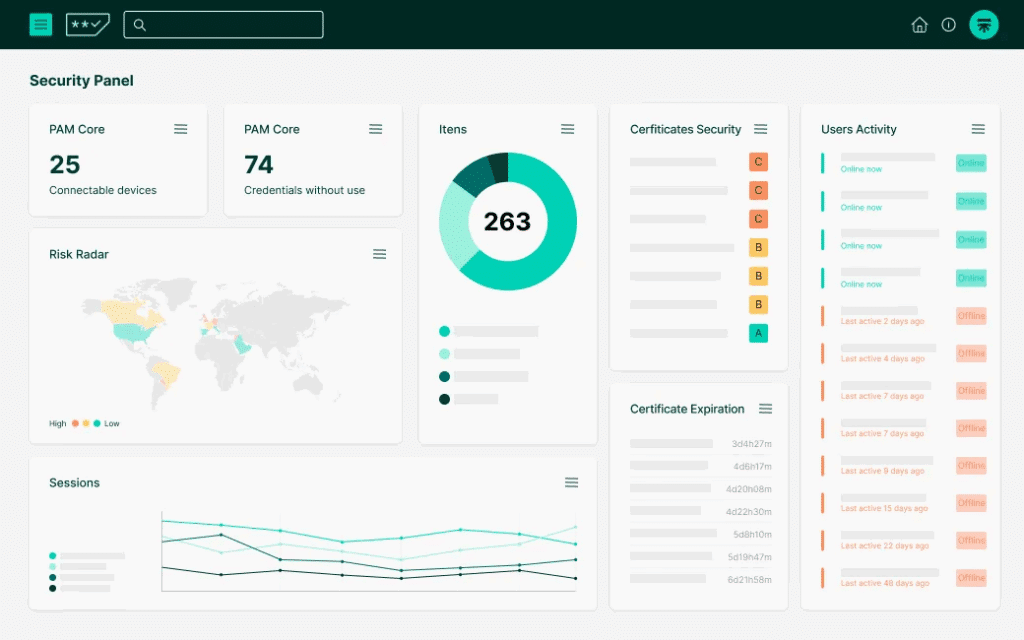
Next up is Segura, an identity security platform that evolved from a PAM solution into a broader identity and access management stack. It provides centralized control over privileged accounts, session recording, and access workflows while also covering general identity and access use cases.
Main Features:
- Built-in integrations to record all privileged sessions for forensic analysis
- Governance over both privileged and non-privileged identities through a unified platform
- JIT elevation and detailed session recording for admins and service accounts
Price: By inquiry.
Best for: All-in-one PAM and identity security platform.
Review: “I would especially highlight the simplicity and speed of use combined with the breadth of functionalities in a single, highly integrated platform.”
5. Doppler
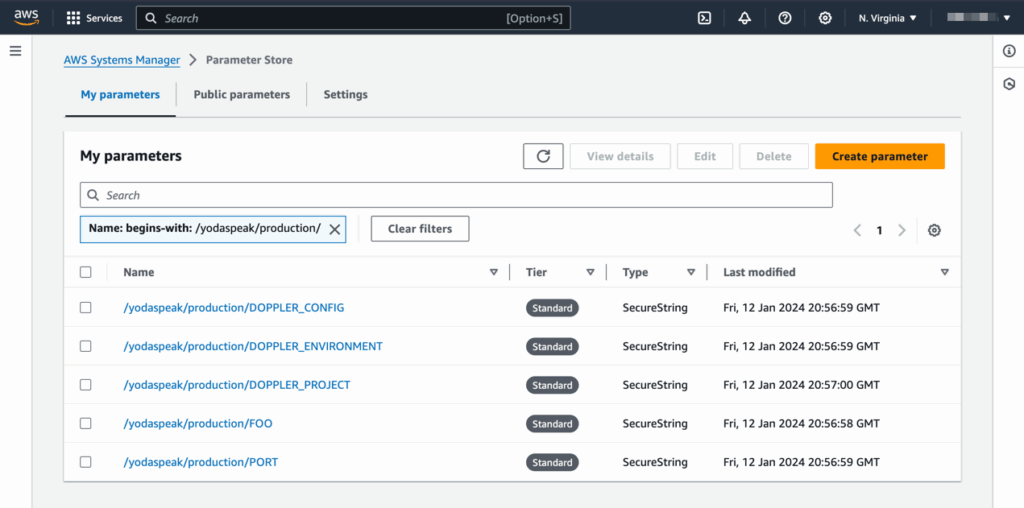
As a secrets and configuration management platform, Doppler centralizes API keys and environment variables for engineering teams. Instead of scattering secrets across CI/CD pipelines and cloud services, Doppler syncs them automatically to apps and infrastructure.
Main Features:
- Audit logs, secret health analytics, and alerts via Slack and Teams
- Dynamic secrets and automatic rotation capabilities
- Centralized secrets store with automatic syncing into CI/CD and runtime environments
Price: Free Developer plan for up to 3 users; Team plan starting around $21/user/month; Enterprise tier is quote-based.
Best for: Centralized secrets and configuration management.
Review: “I really appreciate both the command-line interface and the user interface for managing secrets and keeping them in sync.”
6. Seamfix iAM
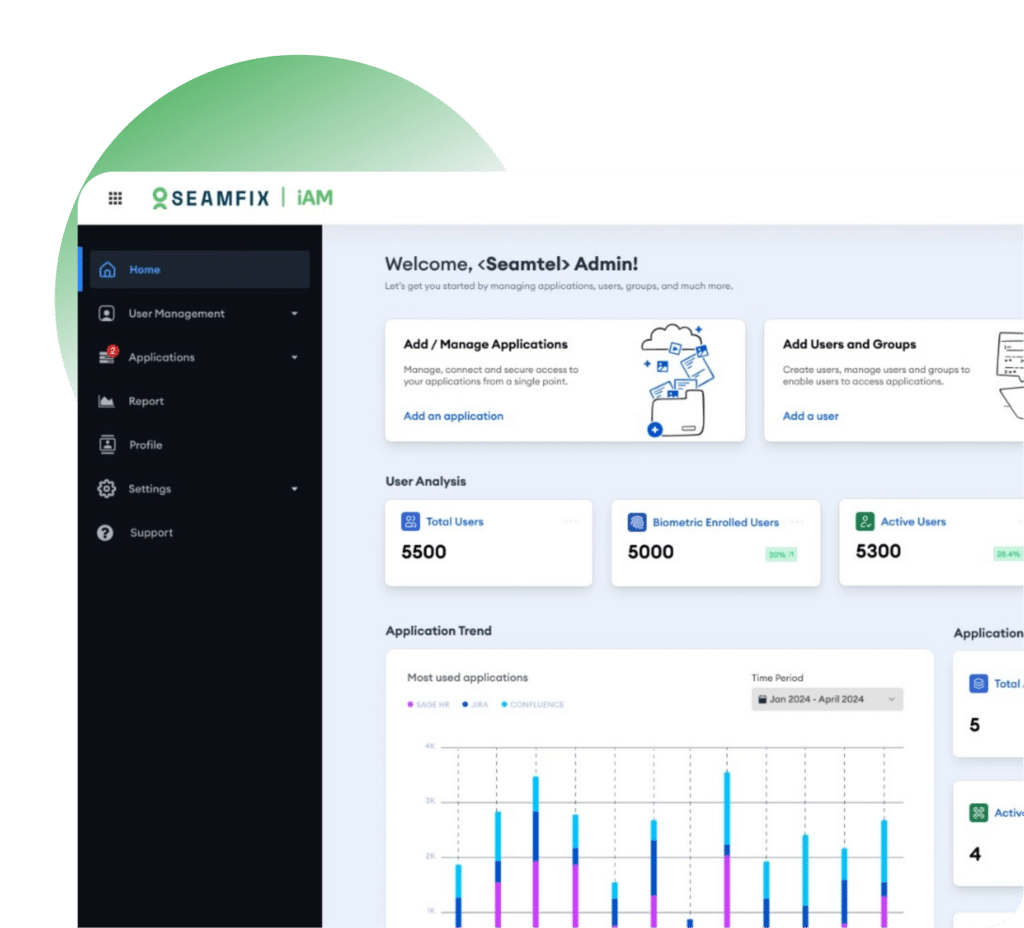
Seamfix iAM is a workforce and citizen identity platform focused on centralized identity lifecycle management and MFA. It provides a unified console to manage user accounts, roles, and application access, helping teams replace manual access management with policy-based automation.
Main Features:
- Strong authentication with MFA and support for biometric login
- Role-based access control and centralized policy management
- Pre-built integrations with common enterprise and SaaS applications
Price: By inquiry.
Best for: Centralized workforce or citizen identity management and MFA.
Review: Not available.
7. Akeyless
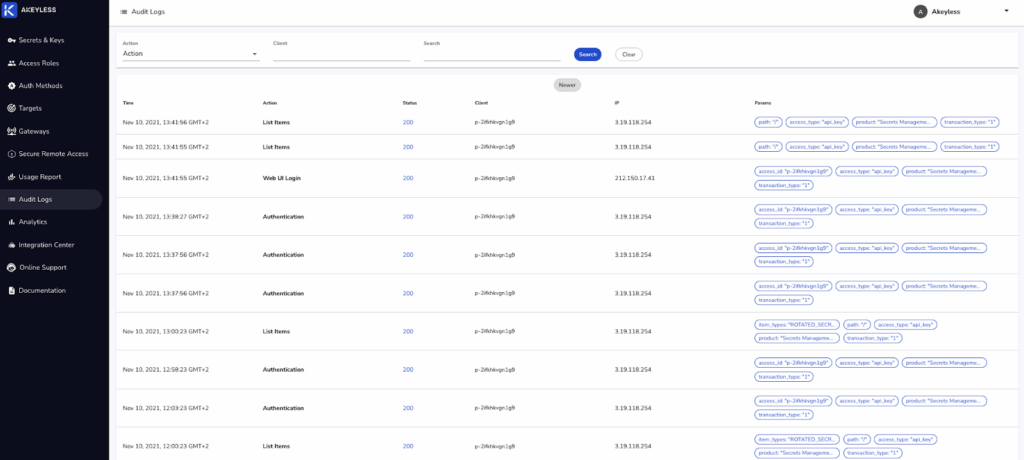
Akeyless is a cloud-native secrets management and modern PAM platform delivered as SaaS. Its “vaultless” architecture is designed to reduce traditional vault complexity while still providing enterprise-grade security and performance.
Main Features:
- Vaultless secrets management to centralize and secure all secret types
- Certificate lifecycle management and “bring your own vault” connectors
- SaaS delivery with high availability and integrations into CI/CD pipelines
Price: By inquiry.
Best for: Consolidating secrets management and modern PAM.
Review: “Akeyless is a one-stop shop for everything—storing secrets, identity services, connecting to third-party tools, encryption, and more.”
8. WSO2 Identity Server

As an open-source, API-driven IAM platform, WSO2 Identity Server supports SSO and MFA use cases. With its extensible architecture, WSO2 is well-suited to organizations that want to deeply customize identity flows.
Main Features:
- High extensibility and API-first design, allowing custom authenticators and integrations
- Support for modern cryptographic standards, including emerging post-quantum-ready capabilities
- Standards-based SSO and identity federation
Price: Free open-source version. Enterprise support is quote-based.
Best for: Customizable, open-source IAM/CIAM platform.
Review: “What I appreciate most about WSO2 Identity Server is its comprehensive support for identity federation and single sign-on (SSO).”
9. FusionAuth
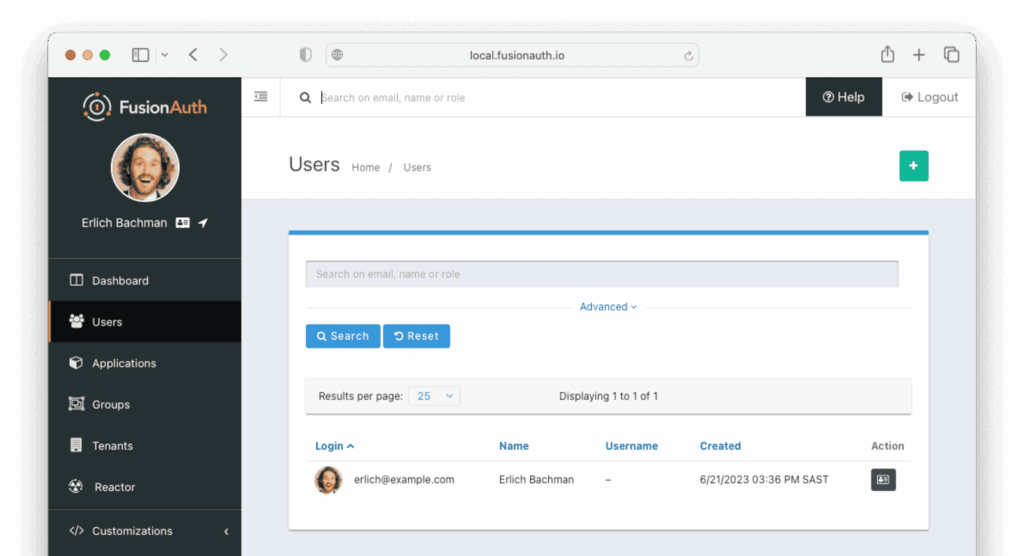
FusionAuth is a developer-focused CIAM platform that can run self-hosted or as a managed cloud service. It provides authentication, SSO, MFA, social login, and user management for consumer-facing applications.
Main Features:
- Flexible deployment: self-host via Docker/Kubernetes or use FusionAuth Cloud
- Advanced features like WebAuthn/passkeys and breached password detection
- SDKs and integration options designed for developer control
Price: The Community option is free. Then, prices rise from $125/month for Starter to $3,300/month for Enterprise.
Best for: Customer-facing authentication and CIAM workflows.
Review: “Their documentation is professionally written and well organized; that, along with their “Ask AI” feature, has made it possible to accomplish some sophisticated configurations.”
10. Infisical
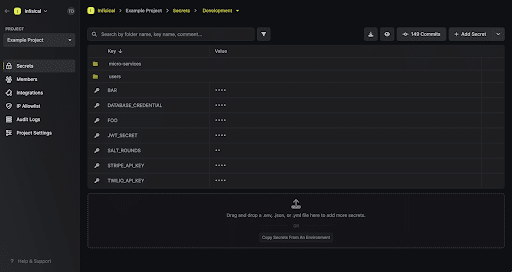
Infisical is an open-source secrets management platform that centralizes application configuration and secrets. It brings secrets, IAM-style access controls, and auditability into a single, Git-integrated workflow.
Main Features:
- Wide integration coverage: GitHub, GitLab, Kubernetes, Docker, major cloud secret managers, etc.
- Temporary access and automated secret rotation tied to expiration
- Enterprise-grade governance via audit logs.
Price: Free open-source version, and enterprise is quote-based.
Best for: Modern, open-source secrets management platform with strong RBAC.
Review: “It is very easy to set up and use – even for some very complex infrastructure environments.”
Table 1: IAM Solution Summary
| Tool | Category | Key Focus / Strengths | Deployment Model |
| Omada Identity Cloud | IGA / Enterprise IAM | Identity lifecycle, access governance, certification campaigns, compliance | SaaS (cloud IGA) |
| Apono | JIT Access / Modern PAM / Access Orchestration | Automated JIT & JEP, auto-expiring permissions, ChatOps-based access, cloud-native integrations | Cloud-native SaaS, API-driven |
| Securden Unified PAM | Privileged Access Management (PAM) | Password & key vaulting, credential rotation, privileged session monitoring | On-prem, private cloud, hybrid |
| Segura (senhasegura) | Identity Security / PAM + IAM | Privileged access, secrets management, identity governance, compliance reporting | SaaS and on-prem options |
| Doppler | Secrets & Config Management | Centralized secrets, CI/CD environment syncing, developer-first workflows | SaaS |
| Seamfix iAM | Workforce / Citizen IAM | Lifecycle management, MFA, RBAC, centralized policy-based access | Enterprise / government deployments |
| Akeyless | Secrets Management + Modern PAM | Vaultless secrets, remote access, certificate lifecycle automation, multi-cloud support | SaaS (cloud-native) |
| WSO2 Identity Server | Open-Source IAM / CIAM | Standards-based SSO, MFA, federation, extensible identity workflows | Open-source; self-hosted or managed |
| FusionAuth | CIAM / App Authentication | Developer-friendly auth, SSO, MFA, flexible hosting | Self-hosted or SaaS |
| Infisical | Open-Source Secrets Management | Encrypted secrets, Git-integrated workflows, RBAC, audit logs | Open-source + cloud SaaS |
Turning IAM into an Identity-First Advantage
Taking an identity-first approach gives you tighter control over identity-related attacks and cleaner audit trails as you scale into more clouds, more SaaS, and exponentially more NHIs. With the right stack, you can leave standing privileges and one-size-fits-all roles in the past, moving towards dynamic, least-privilege access.
Apono is a cloud native orchestration layer that automates time-bound access, granular approvals, and just-enough access for both users and NHIs. It discovers over-permissioned identities and removes risky standing privileges with auto-expiring permissions.
If you’re already investing in IAM, the next step is turning those policies into something your engineers actually feel less, not more. Apono helps teams operationalize Zero Trust in day-to-day workflows: approvals that are contextual instead of manual ticket ping-pong, and guardrails for NHIs that match the sensitivity of the systems they touch.
Ready to see how Apono can plug into your existing stack and eliminate standing privileges for good? For a deeper evaluation, grab the Privileged Access Buyer Guide + RFP Checklist and benchmark your current tools against a JIT-first, identity-driven future.