Apono is now part of 1Password, expanding secure access governance for the AI era

Read More

Cloud-Native Access Governance

Cloud Privileged Access Management Platform That Revokes Access Automatically

Cloud privileged access management should give engineers the access they need, then remove it after the work is done. Apono Privileged Cloud creates Just-in-Time (JIT), just-enough privileges at runtime across AWS, Azure, and GCP, and revokes them automatically.
Why standing privileges are the risk in cloud environments

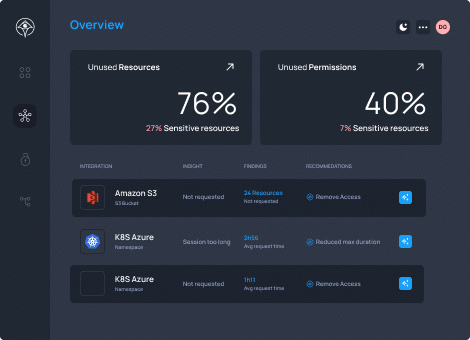
Standing privileges that never expire are the liability most teams can remove but rarely do. They sit across cloud and hybrid systems, waiting for the moment someone, or something, uses them.

The risk is concrete for a security leader. An attacker who compromises one over-privileged identity can move laterally and reach crown-jewel resources. Non-human identities and AI agents can increase this risk, because their permissions may be long-lived, broadly scoped, or difficult to attribute to a clear owner.

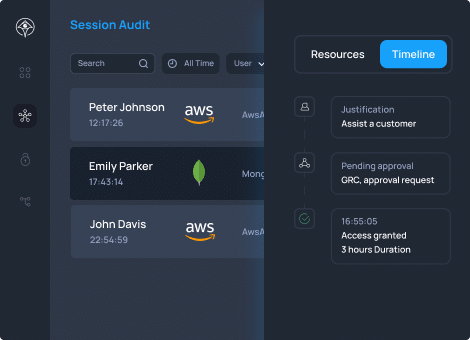
Meanwhile the audit evidence you need to prove control stays scattered across fragmented tooling.

None of this requires a new class of attack. The better state is access that exists only at the moment of need and disappears when the task is done.

Why standing privileges are the risk in cloud environments

Standing privileges that never expire are the liability most teams can remove but rarely do. They sit across cloud and hybrid systems, waiting for the moment someone, or something, uses them.

The risk is concrete for a security leader. An attacker who compromises one over-privileged identity can move laterally and reach crown-jewel resources. Non-human identities and AI agents can increase this risk, because their permissions may be long-lived, broadly scoped, or difficult to attribute to a clear owner.

Meanwhile the audit evidence you need to prove control stays scattered across fragmented tooling.

None of this requires a new class of attack. The better state is access that exists only at the moment of need and disappears when the task is done.

How Apono Privileged Cloud creates access at runtime

Apono, now part of 1Password, creates each privilege at runtime, then removes it at the end of the approved window. The workflow runs in four steps.

The Connector that runs in your environment does not read, cache, or store your secrets. It doesn’t become another place credentials are exposed. Apono governs when and how access is granted without holding the keys itself.

Book a demo

01

Discover
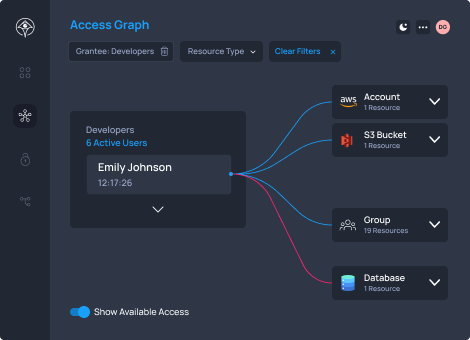
Access Discovery surfaces existing permissions, dormant identities, and overgrown privileges across cloud, CI/CD, and SaaS before any policy is written. You start from a real inventory, not a guess.

02

Request
An engineer requests access through Slack, Teams, or the Apono CLI. Depending on the Access Flow policy, the request can be approved automatically or routed to the appropriate approver.

03

Grant at runtime
Apono Privileged Cloud creates the permission in the target platform’s native policy language, scoped to the specific task, at the moment it’s needed.

04

Revoke automatically
Access is removed the moment the task window closes. No standing credential is left behind for an attacker to find later.

Where teams put cloud privileged access to work

PAM in the cloud shows up in a handful of concrete jobs. Each one replaces a standing grant with access that lasts only as long as the work.

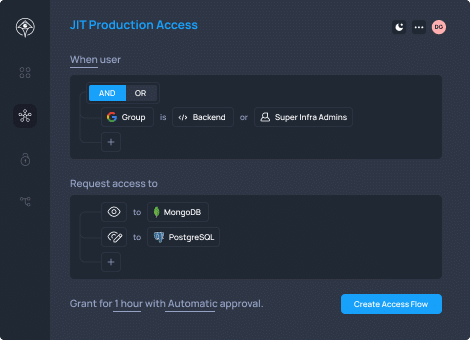
Granting JIT access to production

Engineers reach production infrastructure without holding open-ended admin rights. Access is created for the task and is revoked after a set period of time. Apono customers report provisioning approved access in seconds, along with a materially smaller attack surface.

Granting JIT access to production

Engineers reach production infrastructure without holding open-ended admin rights. Access is created for the task and is revoked after a set period of time. Apono customers report provisioning approved access in seconds, along with a materially smaller attack surface.

Securing access to cloud databases

Database teams get task-specific, temporary credentials instead of standing roles. That covers managed data services such as PostgreSQL and Snowflake, among other common databases, where long-lived access is easy to grant and hard to claw back.

Securing access to cloud databases

Database teams get task-specific, temporary credentials instead of standing roles. That covers managed data services such as PostgreSQL and Snowflake, among other common databases, where long-lived access is easy to grant and hard to claw back.

Running break-glass access during incidents

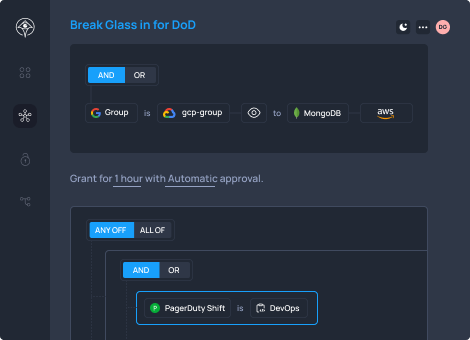
On-call responders get emergency access that is JIT and tightly scoped, with every action audited. Each grant is validated against an incident ticket and revoked after the pre-set window passes. Break-glass access activates in seconds and never lingers afterward.

Running break-glass access during incidents

On-call responders get emergency access that is JIT and tightly scoped, with every action audited. Each grant is validated against an incident ticket and revoked after the pre-set window passes. Break-glass access activates in seconds and never lingers afterward.

Governing non-human identities and AI agents

Non-human identities such as service accounts and workloads, plus AI agents, get scoped, task-specific access instead of inherited, long-lived permissions. Apono Agent Privilege Guard applies Intent-Based Access Control (IBAC) to agents specifically. It ties each permission to the action being taken, with human approval available for sensitive actions.

Governing non-human identities and AI agents

Non-human identities such as service accounts and workloads, plus AI agents, get scoped, task-specific access instead of inherited, long-lived permissions. Apono Agent Privilege Guard applies Intent-Based Access Control (IBAC) to agents specifically. It ties each permission to the action being taken, with human approval available for sensitive actions.

Proof Apono works in restricted cloud environments

Apono is a DevOps-first solution that prioritizes an easy-to-use experience for the end users. Apono is SOC 2 Type II certified and supports customers’ HIPAA, GDPR, PCI DSS, and related compliance programs. It does this by producing access evidence as a byproduct of how access runs.

Apono helps Rho maintain compliance with strict industry regulations, with continuous least privilege access to the environment and sensitive data.

“

“We use Apono for all our environments, from dev and ephemeral environments—all the way to the production.”

Ivan Ivic, DevOps Team Lead, Rho

Integrations

Apono provides more than 200 out-of-the-box integrations across cloud, CI/CD, and SaaS. Coverage keeps expanding, so if a specific tool matters to your evaluation, ask about it directly.

Cloud privileged access management FAQs

Cloud privileged access management is the practice of granting temporary, task-scoped access to cloud infrastructure and services instead of standing, always-on permissions. It relies on JIT provisioning and ZSP, applied to resources that change constantly.

Privileged access management (PAM) governs privileged accounts and the sessions they open across servers, databases, and cloud services. Endpoint privilege management (EPM) removes standing local admin rights on individual endpoints and workstations. They address different layers and work well together.

PAM tools fall into a few types. Legacy vault-centric platforms include CyberArk, Delinea, and BeyondTrust. Identity-provider-native tools include Microsoft Entra PIM and Okta Privileged Access. Cloud-native JIT platforms include Apono and Britive.

Cloud environments change by the minute, so access provisioned broadly and left in place accumulates risk with no offsetting benefit. On-premises infrastructure is comparatively static, so standing access ages more slowly. Cloud privileged access management answers this by creating access at runtime.

Setup takes some planning, and customers describe a slight learning curve at the start. The sequence is straightforward: install a Connector, integrate your cloud apps, run Access Discovery, then create your first Access Flow. Most customers deploy across their organization within about two weeks, though timelines vary by environment and setup scope.

Apono’s JIT access governance is now part of 1Password Privileged Access within the 1Password Unified Access platform. This gives teams a broader way to discover, secure, and audit access across human, machine, and AI identities. Organizations can reduce standing privileges across cloud systems while connecting privileged access with 1Password’s credential and identity security capabilities.

See Apono Privileged Cloud in action

Standing access is the risk you can remove today. Apono Privileged Cloud gives your teams access that exists only at the moment of need, then takes it back automatically. Book a demo to see real product UI. No long-term contract is required to evaluate.