
Apono is now part of 1Password, expanding secure access governance for the AI era

Read More

Use Case

Non-Human IdentityManagement Platform

Find every service account, API key, and workload identity with access to your infrastructure, then replace their standing permissions with task-scoped access that expires on its own. Apono, now part of 1Password, applies the same Just-in-Time model to machines and AI agents that it applies to engineers, from one policy plane.

Unmanaged non-human identities can widen your blast radius

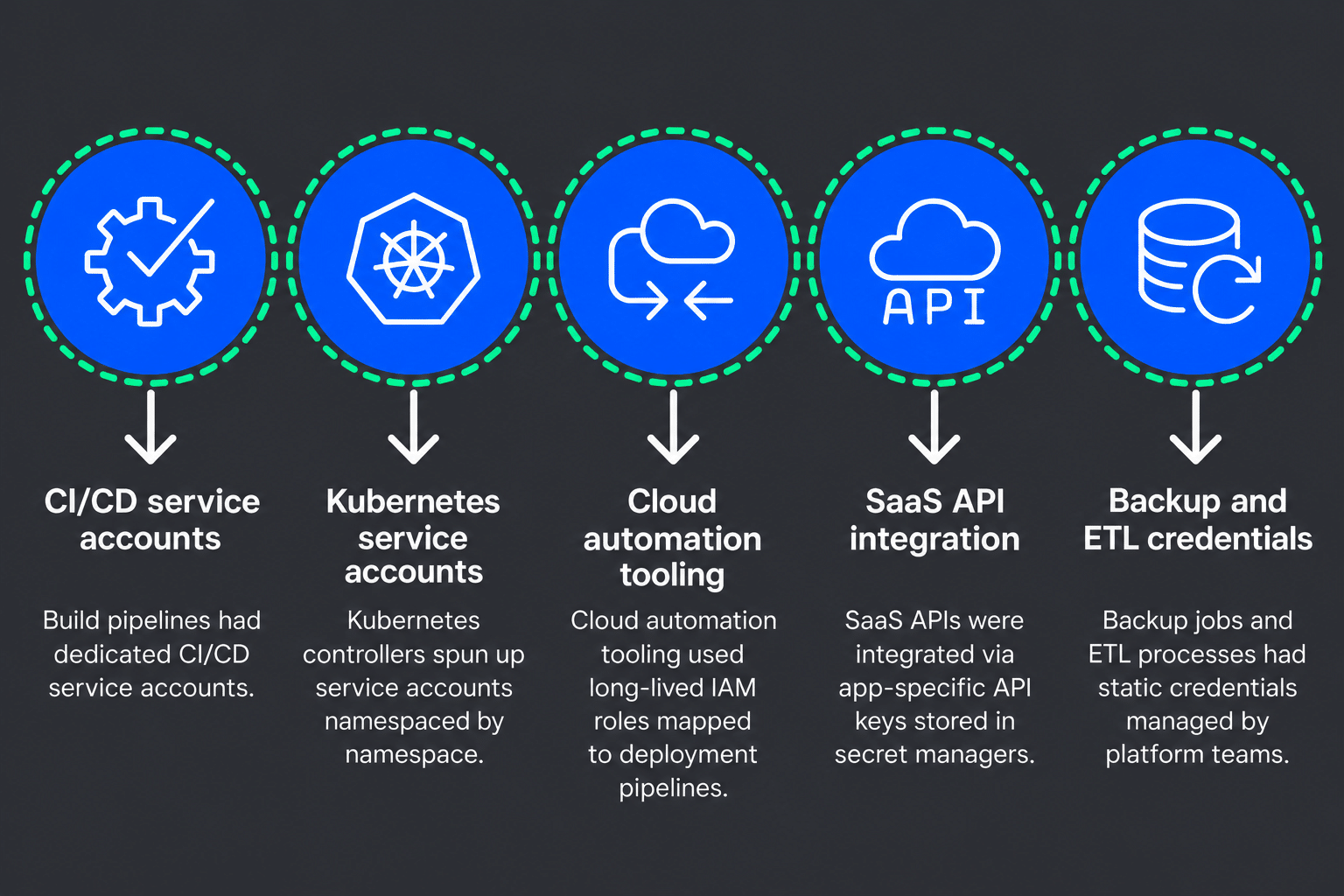
A non-human identity (NHI) is any identity that isn’t a person: service accounts, API keys, tokens, CI/CD pipelines, workloads, and AI agents. Non-human identity management is how you find those identities, control what they can reach, and remove access they no longer need.

Most NHIs get their permissions once, at setup, and keep them. A deploy pipeline gets admin rights so the build never fails. A service account created for a migration two years ago still holds write access to production. Because these identities may be long-lived, broadly scoped, or hard to tie to a clear owner, they can become the easiest path for an attacker who finds one exposed token. Human-centric access tools weren’t built to govern them, so the risk often grows without anyone reviewing it.

How It Works

How Apono handles non-human identity management

Apono treats machine access the way it treats human access: nothing standing, everything scoped and time-bound. The work starts with what already exists, then moves new access onto a Just-in-Time model:

›
01
Discover
Access Discovery finds service accounts, tokens, and dormant identities across cloud, CI/CD, and SaaS, along with the permissions each one holds.
›
02
Prioritize
Apono scores each identity by permission sensitivity, resource risk, and observed usage, so your team fixes the riskiest access first.
›
03
Right-size
Broad permissions are converted to Just-Enough access, and unused identities can be quarantined before you remove them.
›
04
Grant
When a pipeline, workload, or AI agent needs elevated access, it requests it through an Access Flow. Depending on the Access Flow policy, the request can be approved automatically or routed to the appropriate approver.
05
Revoke
Access expires automatically at the end of the approved window, and every grant is logged.

What a non-human identity management solution changes for your team

Moving machine access onto a Just-in-Time model pays off for the security team that owns the risk and the platform team that owns the pipelines:

Less standing machine access. Unused and overprivileged NHIs are flagged for cleanup, and broad permissions shrink to what each identity actually uses.
Clear attribution. See which service account reached which resource and why.
Reduce disruption during remediation. Use observed activity and reversible quarantine controls, then validate permission changes against pipeline requirements.
Audit evidence as a byproduct. Every request, approval, grant, and revocation is logged, which supports SOC 2, ISO 27001, HIPAA, PCI DSS, SOX, and GDPR programs and helps improve audit readiness.
Apono is SOC 2 Type II certified. Its access records help security and compliance teams demonstrate how machine privileges are controlled.

Case Study

Granular, temporary permissions in practice

Cybereason uses Apono to generate temporary, granular permissions on request across GCP and F5. That replaced a manual provisioning step and removed hours of work each week for its R&D operations and security teams.

“Apono allows us to generate temporary permissions upon request on a very granular set of restrictions, delivering huge value to the business by reducing the manual provisioning phase and optimizing the day-to-day work of multiple teams, including the R&D operations and security teams.”

Alan Idelson, CISO, Cybereason

Read the Cybereason story →

Where Apono’s NHI management fits your workflow

Discovery and governance in one place

Some NHI tools stop at finding and monitoring identities. Apono discovers them and then governs what they can do, so the same platform that flags an overprivileged service account can right-size it and put its future access on a time-bound Access Flow.

Discovery and governance in one place

Some NHI tools stop at finding and monitoring identities. Apono discovers them and then governs what they can do, so the same platform that flags an overprivileged service account can right-size it and put its future access on a time-bound Access Flow.

Connector architecture

The Apono Connector runs in your environment and doesn’t read, cache, or store secrets. It can link to the secrets manager or cloud vault you already use, so governing machine access doesn’t create a new place for credentials to pile up.

Connector architecture

The Apono Connector runs in your environment and doesn’t read, cache, or store secrets. It can link to the secrets manager or cloud vault you already use, so governing machine access doesn’t create a new place for credentials to pile up.

Setup and time-to-value

Most customers deploy access control across their organization within about two weeks. Teams usually start with Access Discovery, clean up the highest-risk NHIs, then move one service or pipeline at a time onto Just-in-Time access. Apono connects through 200+ out-of-the-box integrations across cloud, Kubernetes, databases, and CI/CD.

Setup and time-to-value

Most customers deploy access control across their organization within about two weeks. Teams usually start with Access Discovery, clean up the highest-risk NHIs, then move one service or pipeline at a time onto Just-in-Time access. Apono connects through 200+ out-of-the-box integrations across cloud, Kubernetes, databases, and CI/CD.

One policy plane for people, machines, and agents

The same Access Flows govern engineers, service accounts, and AI agents, so you don’t run separate tools with separate rules. AI agents get task-scoped access instead of inherited human privileges, and sensitive actions can require human approval. For agent-specific controls, see Apono Agent Privilege Guard.

One policy plane for people, machines, and agents

The same Access Flows govern engineers, service accounts, and AI agents, so you don’t run separate tools with separate rules. AI agents get task-scoped access instead of inherited human privileges, and sensitive actions can require human approval. For agent-specific controls, see Apono Agent Privilege Guard.

Non-human identity management FAQs

Non-human identity management is the practice of finding machine identities, such as service accounts, API keys, tokens, workloads, and AI agents, and controlling what they can access. Apono does this by discovering existing NHI permissions, right-sizing them, and granting new access just in time so it expires automatically.

Non-human identities can increase risk because their permissions may be long-lived, broadly scoped, or hard to attribute to a clear owner. An exposed token with standing access can give an attacker a path to sensitive systems that nobody is watching.

Look for discovery across cloud, CI/CD, and SaaS, risk scoring based on real usage, and a safe way to quarantine unused identities. The tool should also govern access going forward, with time-bound grants and a full audit trail, rather than only reporting on risk.

Start with coverage: the tool should reach every environment your machine identities touch. Then check whether it can change access as well as report on it, whether it stores your secrets, and whether it governs people, machines, and AI agents under one set of policies.

Apono gives AI agents task-scoped, time-bound access through the same Access Flows used for people and service accounts, and sensitive actions can require human approval. Agent-specific controls live in Apono Agent Privilege Guard.

Take standing access away from your machine identities

Find the service accounts and tokens holding access nobody reviews, right-size them, and move their future access onto time-bound Access Flows. See how Apono brings non-human identities under the same Just-in-Time model as your engineers.