8 Best Cloud PAM Solutions in an AI World

The Apono Team
October 28, 2025
AI is rewriting the rules of privileged access, but the rise of AI agents is creating a governance crisis. Threats like credential stuffing and privilege escalation are now accelerated by autonomous systems moving faster than humans can react.
82% of companies deploy autonomous AI agents, but 23% of IT teams admit those bots have already been tricked into revealing credentials—and fewer than half have guardrails in place. In modern infrastructure, machine identities now outnumber humans 80:1. These non-human identities (NHIs) power everything from APIs to AI pipelines, and each one needs access.
The problem? Legacy PAM tools, which remain vault-centric, weren’t built for this scale. Cloud PAM solutions step in with just-in-time, least-privilege access to shrink your attack surface and keep both humans and machines in check.
What are cloud PAM solutions?
Privileged Access Management (PAM) controls and monitors the use of accounts with elevated permissions. It is closely related to enterprise identity management, and traditional PAM meant vaults, long-lived credentials, heavy-handed approvals, and developer friction.
Cloud PAM solutions are the modern evolution of PAM, purpose-built for cloud-native and API-driven environments. Instead of relying on static roles and clunky approvals, cloud PAM delivers on-demand, time-bound access through automation and integrations. These solutions use Just-In-Time (JIT) access to issue ephemeral credentials that expire automatically, ensuring no leftover privileges are waiting to be exploited.
Cloud PAM is designed to secure not just human admins but also the massive number of non-human identities (service accounts, API keys, and ML pipelines) that dominate today’s AI-driven workloads.
Table 1: Legacy vs Cloud PAM
| Feature | Legacy PAM | Cloud PAM |
| Architecture | Built for on-premises, data center environments | Cloud-native, API-first, designed for distributed systems |
| Access Model | Static roles and long-lived credentials stored in vaults | Just-In-Time (JIT) access with ephemeral, auto-expiring permissions |
| Deployment | Heavy agents, complex setup | Lightweight integrations, deploys quickly in cloud stacks |
| Scope of Protection | Focus on human administrators | Secures both human and non-human identities (service accounts, API keys, ML pipelines) |
| Scalability | Limited flexibility, difficult to scale across multi-cloud | Dynamic, scalable for cloud-native and AI workloads |
| Risk Exposure | Standing privileges, static secrets, higher attack surface | Least-privilege, time-bound access reduces attack surface |
Why Cloud PAM Solutions are Essential in an AI-Driven World
AI workloads bring massive growth in both human and non-human identities, and here are four reasons why cloud PAM solutions are superior for modern problems:
- Scale with automation: Automates provisioning and revocation for thousands of service accounts, agents, and pipelines.
- Simplify compliance: Automated logs and reports reduce the time and cost of preparing evidence for frameworks like HIPAA and SOC 2.
- Extend zero trust: Applies strict verification and time-bound access to both human and non-human identities.
- Reduce attack surface: Automated remediation and vulnerability management help eliminate standing privileges, shrinking the impact of stolen or misused credentials.
🔍 Evaluate Your Next Cloud PAM Move
Not all PAM tools were built for AI-driven environments. Download the Access Platform Buyer’s Guide to see how leading security teams evaluate Cloud PAM capabilities — from Zero Standing Privilege to Non-Human Identity control.
Key Features to Look For in a Modern Cloud PAM Solution
Not all PAM platforms are built for cloud-native, AI-driven environments. When evaluating modern cloud PAM tools, these features should be at the top of your list:
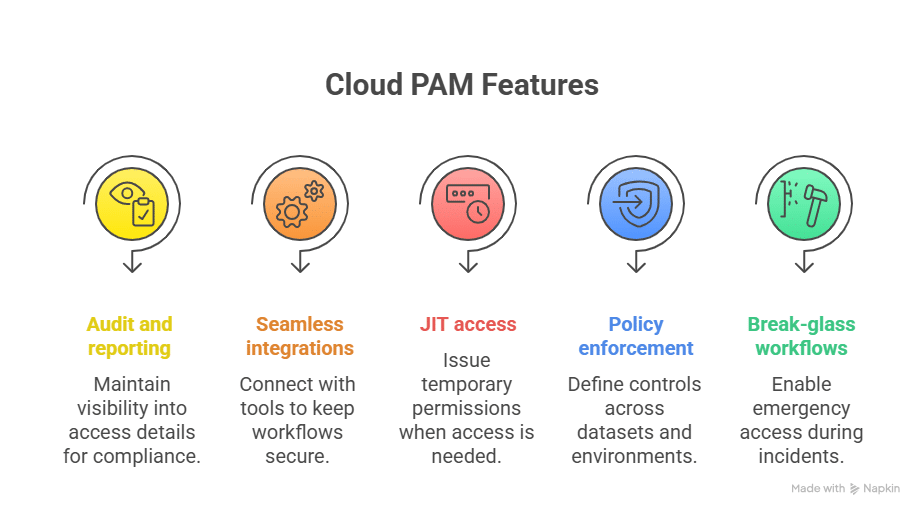
- Comprehensive audit & reporting: Maintain full visibility into who accessed what, when, and why, which is critical for meeting compliance standards.
- Seamless integrations: Connect easily with Slack, Teams, CI/CD pipelines, cloud providers, and AI dev tools to keep workflows fast and secure.
- JIT access: Issue temporary, auto-expiring permissions so humans and non-human identities get access only when needed.
- Granular policy enforcement: Define fine-grained controls across AI datasets, ML training clusters, APIs, and multi-cloud environments.
- Break-glass and on-call workflows: Enable pre-approved emergency access during incidents without sacrificing control or visibility.
How to Choose the Best Cloud PAM Solutions for AI Workloads
With so many cloud PAM tools on the market, choosing the right one for AI-heavy environments means focusing on more than just credential storage. Here’s what to look for:
- AI/ML integration support: Ensure the platform integrates smoothly with Kubernetes clusters, GPU workloads, data lakes, and other components of your ML pipeline.
- Automation-first design: Prioritize solutions that provide JIT access, auto-revocation of permissions, and policy-driven workflows at scale.
- Regulatory readiness: Check that the solution simplifies compliance with HIPAA, GDPR, SOC 2, and other standards relevant to AI workloads.
- Developer-friendly experience: Look for ChatOps and CLI access so engineers can request and receive permissions instantly without waiting on ticket queues.
8 Best Cloud PAM Solutions for the AI World
Let’s break down the best privileged access management software options for cloud-native and AI-driven workloads.
1. Systancia
The Systancia Cleanroom solution enables session isolation and real-time monitoring to protect critical systems from credential theft and insider threats. Unlike traditional vault-centric PAM, Systancia delivers a cloud-native approach that prioritizes user experience and regulatory compliance.
Main Features:
- Apply enhanced authentication and continuous identity checks (e.g., “Cleanroom Authograph”).
- Supports multiple deployment modes: on-premises, hybrid, or cloud.
- Adapts traceability, control, and protection levels depending on the criticality of the intervention (e.g., standard / advanced / full levels).
Best for: Regulated industries needing strong session isolation.
Price: By inquiry.
Review: “It’s easy to understand and use. [I like the features, such as] password rotation, recording sessions, white room administration, MFA, [and more].”
2. Apono

Apono is a cloud-native access management platform purpose-built for the scale and speed of modern, AI-driven environments. Unlike vault-based PAM, Apono delivers an API-first model that automates JIT and least privilege access for both human and non-human identities. By issuing ephemeral, auto-expiring permissions, Apono ensures users and services get precisely the access they need—only when they need it.
Main Features:
- On-demand, self-serve access from Slack, Teams, or CLI.
- Automatic provisioning and revocation for humans and service accounts to strengthen your machine identity management posture.
- Audit logs that show exactly who accessed what, when, and why.
- Cloud connectors that deploy in under 15 minutes.
- Break-glass and on-call flows for fast, controlled incident response.
- Scoped, time-limited vendor access to prevent external overreach.
Best for: Cloud-native organizations running AI/ML pipelines that need to secure both human and non-human identities with fast, just-in-time access.
Price: By inquiry.
Review: “As a SecOps Manager implementing the Apono platform, I experienced significant improvements in our organization’s security posture, operational efficiency, and compliance capabilities.”
3. Wallix Bastion
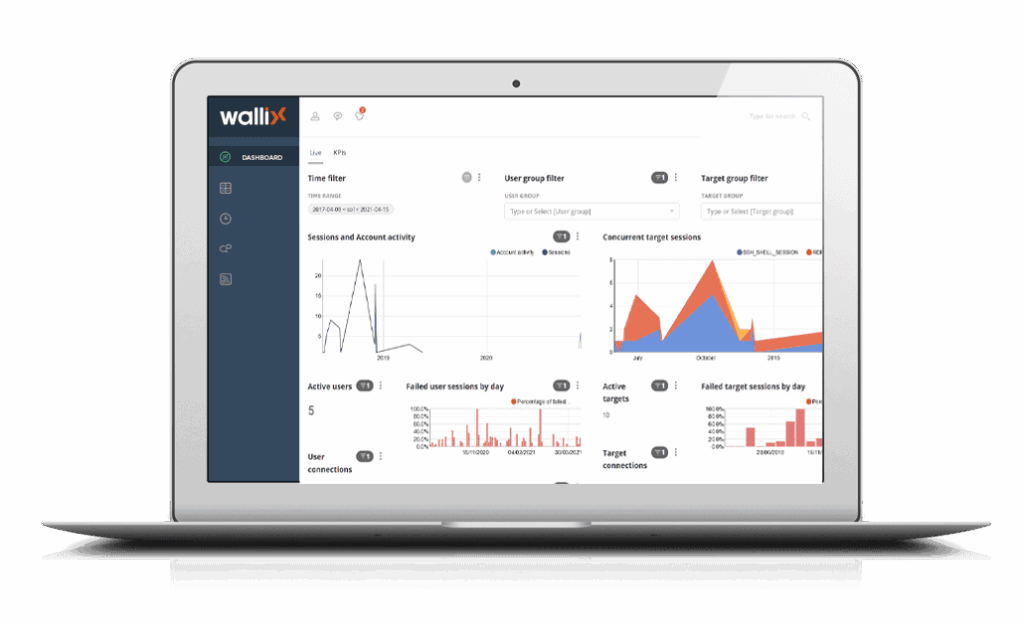
Wallix Bastion’s PAM platform focuses on delivering secure, auditable control over administrative accounts in hybrid and multi-cloud environments. Gartner recognizes it for helping enterprises enforce the least privilege and monitor privileged activity.
Main Features:
- Available on-premises, in the cloud, or as a managed service.
- Provides temporary, context-based access to privileged accounts.
- Securely stores, rotates, and manages privileged account credentials with password vaulting.
Best for: Enterprises requiring centralized credential management.
Price: By inquiry.
Review: “WALLIX PAM provides strong security for privileged access management with an intuitive interface, real-time monitoring, and robust audit logs.”
4. StrongDM

StrongDM is a modern infrastructure access platform that approaches PAM differently. Instead of traditional password vaults, it focuses on secure, dynamic connectivity. It gives developers, DevOps, and security teams centralized control over access to databases, servers, Kubernetes clusters, and cloud environments.
Main Features:
- Captures detailed logs of every session, command, and query for compliance and troubleshooting.
- Integrates into existing workflows, with support for CLI and SDKs.
- Eliminate the need for long-lived secrets by brokering connections directly.
Best for: DevOps teams wanting frictionless, VPN-free access to databases, servers, and Kubernetes.
Price: By inquiry.
Review: “The integration capabilities are top-notch, allowing us to embed StrongDM into complex environments with minimal friction.”
5. Teleport

Teleport is an open-source platform that unifies secure access to servers, databases, Kubernetes clusters, and internal applications under a single, identity-based solution. Teleport uses certificates and short-lived credentials to provide strong, auditable privileged access.
Main Features:
- Records all SSH, Kubernetes, and database sessions with full visibility for compliance.
- Integrates with SSO/IdPs (Okta, Azure AD, etc.) to enforce fine-grained least privilege.
- Built-in identity-aware proxy ensures every request is authenticated and authorized without relying on a VPN.
Best for: Engineering teams favoring open-source, zero trust access with short-lived certificates.
Price: Open-source version is free; enterprise pricing available by inquiry.
Review: “The session recording and audit logging features are incredibly useful for compliance and troubleshooting.”
6. CyberArk Privileged Access Manager
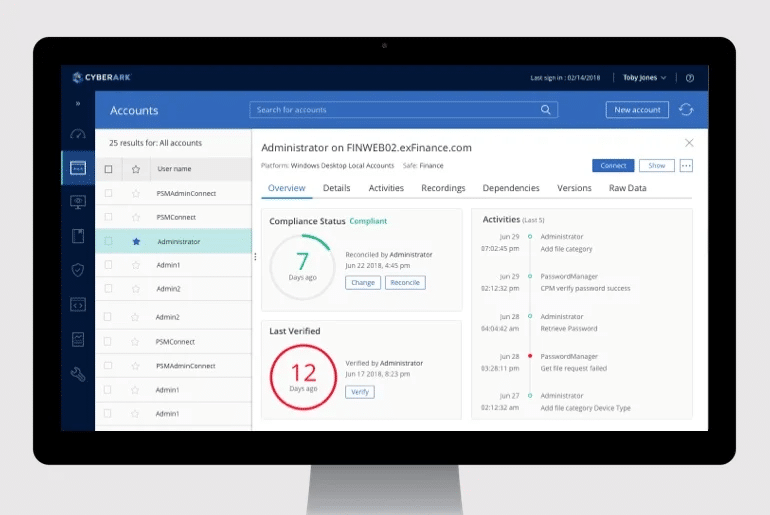
CyberArk’s PAM solution combines credential vaulting, session monitoring, and threat detection to deliver enterprise-grade control over privileged accounts in hybrid and cloud environments.
Main Features:
- Leverages AI-driven monitoring to detect anomalies in privileged account usage.
- Integrates with identity providers, cloud services (AWS, Azure, GCP), and DevOps pipelines.
- Eliminates standing privileges by provisioning temporary, role-based access to critical assets.
Best for: Large enterprises and highly regulated sectors needing enterprise-grade PAM with vaulting and anomaly detection.
Price: By inquiry.
Review: “CyberArk Privileged Access Management (PAM) is an excellent tool for any organization looking to protect privileged access to critical systems and sensitive data.”
7. Netwrix

Netwrix Privilege Secure is part of Netwrix’s suite, which delivers end-to-end privileged access control with task automation and compliance built in. It’s designed to eliminate standing privileges and make administrative access safer and easier to manage across hybrid environments.
Main Features:
- Automates high-risk tasks (patching, password resets, etc.) with workflows and ephemeral access.
- Provides time-limited, MFA-protected access for remote or third-party users.
- Full session recordings, keystroke/log capture, and approval and activity logs.
Best for: Organizations battling privilege sprawl who need continuous discovery.
Price: By inquiry.
Review: “[I like the] do-it-yourself proof of concept, open and straightforward commercial track, variety of architectural designs, and seamless rollout.”
8. JumpCloud
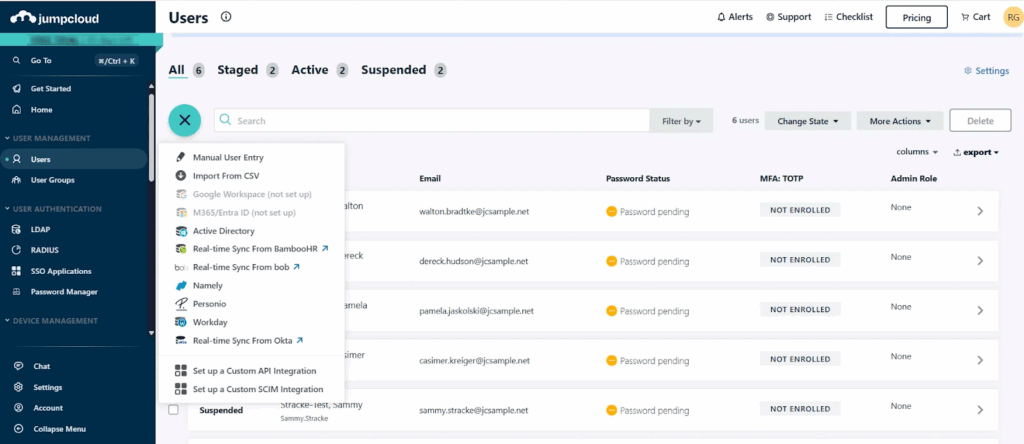
While it’s broader than traditional PAM, JumpCloud is an open directory platform with privileged access capabilities designed to help organizations manage admin rights, enforce least privilege, and secure hybrid IT environments.
Main Features:
- Controls and secures privileged access on Windows, macOS, and Linux devices.
- Extends secure, frictionless access to apps and infrastructure with built-in MFA and SSO across thousands of SaaS apps.
- Assigns granular admin rights and enforces just-in-time elevation of privileges.
Best for: IT teams consolidating identity, device, and privileged access management into a single, all-in-one cloud directory platform (although PAM is not its core strength).
Price: Free plan available; paid plans start per user/month, with enterprise pricing by inquiry.
Review: “As a developer, I really appreciate the smooth integrations with different tools and the straightforward APIs—it saves a lot of time when setting up authentication and access controls.”
Table 2: Best Cloud PAM Solutions in a Snapshot
| Solution | Main Features | Best For | Price |
| Systancia | Enhanced authentication, multiple deployment modes, adaptive control levels | Regulated industries needing strong session isolation | By inquiry |
| Apono | JIT access, self-serve via Slack/Teams/CLI, auto-expiring credentials, detailed audit logs, fast deployment | Cloud-native orgs running AI/ML pipelines securing human & non-human identities | By inquiry |
| Wallix Bastion | On-prem, cloud, or managed service; context-based temporary access; password vaulting | Enterprises requiring centralized credential management | By inquiry |
| StrongDM | Session & query logs, CLI/SDK integrations, connection brokering (no static secrets) | DevOps teams wanting frictionless, VPN-free infra access | By inquiry |
| Teleport | Certificate-based access, session recording, IdP integration, identity-aware proxy | Engineering teams favoring open-source, Zero Trust access | Free OSS; enterprise pricing by inquiry |
| CyberArk | Credential vaulting, anomaly detection, integrations with major clouds/IdPs, JIT access | Large enterprises & regulated sectors needing enterprise-grade PAM | By inquiry |
| Netwrix | Privileged task automation, MFA-protected temporary access, detailed auditing & compliance logs | Orgs battling privilege sprawl needing continuous discovery | By inquiry |
| JumpCloud | Cross-platform device control, SSO & MFA, granular admin rights with JIT elevation | IT teams consolidating identity, device, and privileged access | Free plan; paid per user/month |
Securing Privileged Access in the AI Era
In an AI-first enterprise, privileged access is both the biggest enabler and the greatest risk. Cloud PAM solutions help organizations scale securely, replacing static controls with just-in-time, least-privilege access.
Apono is built for this world: API-driven, cloud-native, and designed to protect non-human identities. With ephemeral, auditable permissions, your teams move fast and your auditors stay happy. See Apono in action to explore how it secures AI workloads without slowing developers.