AI Agent Authentication: An InfoSec Guide

The Apono Team
July 29, 2026
Abstract
AI agent authentication is the process of verifying that an autonomous agent is the identity it claims to be before it interacts with infrastructure, applications, APIs, or data. Because agents often act on behalf of users, services, or workflows, authentication must be paired with delegated context and downstream authorization controls that determine what the agent is allowed to do, which resource it can access, and how long that access should last.
This article covers:
- Why traditional authentication breaks down for AI agents
- The biggest authentication risks for AI agents
- What secure AI agent authentication should include
- Why Just-in-Time access matters for AI agents
- AI agent authentication best practices checklist
Your AI agents have stopped waiting for instructions, and they’ve evolved from passive assistants into active, autonomous participants operating directly within your production environments.
Credential abuse accounted for 22% of breaches as an initial attack vector, making it one of the most common ways attackers infiltrate an organization. As such, agent access is a real identity-security problem, not just an AI governance concern. Without the right controls, these dynamic identities can become an easy path for lateral movement and data exfiltration.
This shift in security is critical because agents now handle direct connections to sensitive cloud infrastructure, enterprise databases, and mission-critical CI/CD systems. If you continue to rely on static, long-lived credentials, you are leaving your most sensitive assets exposed to the unpredictable nature of agentic workflows.
What is AI agent authentication?
In practice, AI agent authentication gives each agent a verifiable identity before it can call APIs, query databases, trigger workflows, or access infrastructure. Unlike traditional methods that rely on static passwords and long-lived credentials, it governs identities that act on behalf of a user, service, or business objective.
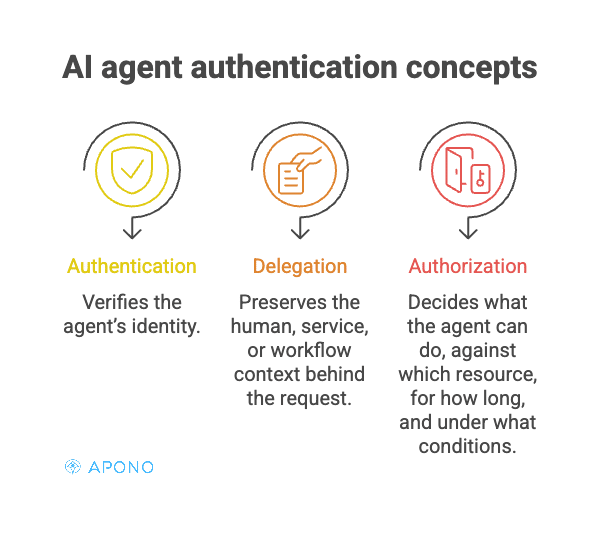
Three concepts matter here.
- Authentication verifies the agent’s identity.
- Delegation preserves the human, service, or workflow context behind the request.
- Authorization decides what the agent can do, against which resource, for how long, and under what conditions.
For AI agents, authentication is only the starting point. Security teams also need delegated context, task-scoped authorization, short-lived credentials, and runtime guardrails that control what the agent can do after identity is verified.
Many LLM-based AI agents can behave non-deterministically. A single input can produce different outcomes, especially when agents chain tools, interpret prompts, or respond to changing context. They also carry side effects by design, such as modifying databases, triggering APIs, or writing files.
Because agents act as intermediaries between users and external software, they are non-human identities. The goal is to reduce the chance that, if an agent is compromised, attackers can use its permissions to move laterally or access unintended data.
For example, a refund agent should authenticate as a unique identity, preserve the user or workflow that triggered the refund, and authorize only the required actions. Without those constraints, an attacker could jump from checking refund status into sensitive systems like user databases or CI/CD pipelines.
Why Traditional Authentication Breaks Down for AI Agents
Traditional authentication models were built for predictable, human-centric workflows: a user logs in, performs a known action, and logs out. AI agents break that model because they make real-time decisions, chain third-party tools, and handle dynamic contexts that static security policies can’t fully map. This gets even harder in multi-agent workflows, where agents hand off tasks, share context, and depend on consistent runtime definitions to avoid conflicting or unexpected actions.
Because many production agents run as headless workloads without a human in the loop, interactive methods like MFA are difficult to apply to every action. RBAC also becomes incomplete on its own. It relies on stable roles, while an agent’s access needs are fluid, task-specific, and temporary. To avoid mid-task permission errors, teams often over-provision access, creating a major security blind spot.
Static service accounts create the same problem. They authenticate the workload, but they don’t explain why the agent needs access now, who initiated the request, whether the action matches the original intent, or when access should expire. Broad OAuth scopes, CI/CD secrets, and shared API keys make this worse by giving agents standing reach into tools and data before a valid prompt or task appears.
| Traditional auth pattern | Why it creates risk for AI agents |
| Human credentials | Blurs whether a human or an agent performed the action |
| Shared service accounts | Makes accountability and audit trails weak |
| Long-lived API keys | Creates standing access that attackers can reuse |
| Broad OAuth scopes | Gives agents more access than the task requires |
| Static RBAC roles | Doesn’t reflect changing intent, resource risk, or session context |
| No runtime authorization or approval | Allows sensitive actions to execute without policy checks or human review |
The Biggest Authentication and Access Risks for AI Agents
Human credentials and shared tokens
Accountability disappears when AI agents authenticate with human credentials or generic service accounts. You can’t tell whether a database change was a legitimate user action or the result of an agent’s decision-making. Token and credential sprawl also lets agents access internal data they shouldn’t, while obscuring who or what made the request.
Long-lived credentials
Long-lived API keys and stale tokens create permanent standing access. If an agent is compromised, an attacker inherits a persistent, unattended entry point into your infrastructure. These credentials don’t reflect the agent’s changing intent, so access stays “on” long after the task is finished.
For DevOps teams, this includes CI/CD secrets, broad OAuth tokens, cloud access keys, and rarely rotated service-account credentials. Once they spread across pipelines, logs, local environments, and automation tools, they become hard to inventory and revoke quickly.
Overprivileged agents
To avoid constant access requests, teams often grant agents broad OAuth scopes, admin-like roles, or, in worst cases, root credentials. This gives agents far more power than any single task requires. OWASP describes this risk as excessive agency, where an LLM-based system has too much functionality, too many permissions, or too much autonomy. Prompt injection can manipulate the agent into misusing its legitimate permissions to commit illegitimate actions, such as exfiltrating data or reconfiguring systems.
Weak provenance and auditability
Multi-agent AI workflows make delegation chains hard to trace. When one agent hands off a task to another, the original intent and authorization source can become obscured. Without clear provenance, security teams struggle to monitor agent sprawl, identify anomalous behavior, and prevent lateral movement.
What Secure AI Agent Authentication Should Include
To overcome the shortcomings of legacy security, you need to move from static, standing access to a framework that sees each agent interaction as a unique, time-bound event. The objective is to give each identity ephemeral, scoped access, creating credentials when a request is made and revoking them when the session concludes.
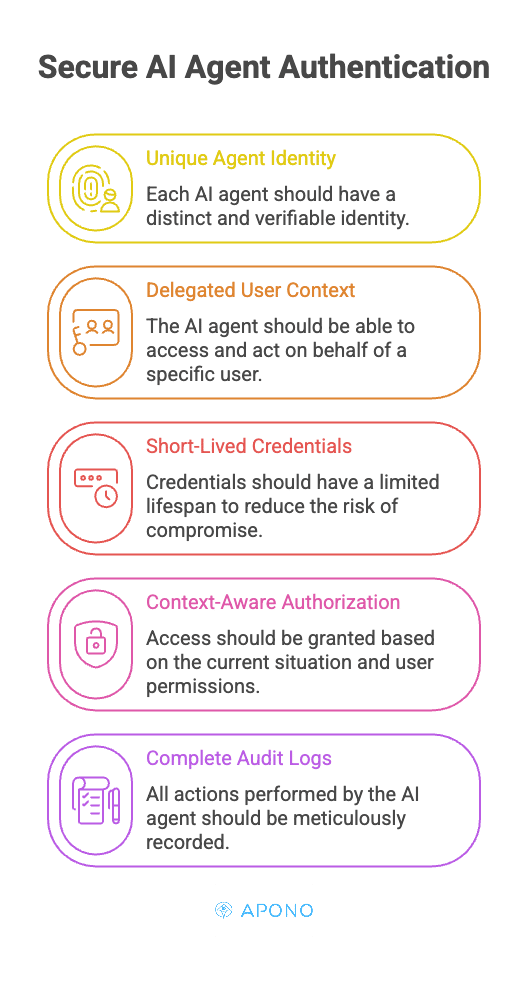
1. Unique agent identity
Each AI agent needs a unique identity record that includes its individual owner, its declared purpose, the environment in which it operates, and a list of approved tools it can touch. This unique identity reduces the risk of “anonymous” agents and helps ensure that each action is associated with an authorized entity.
This identity should be separate from human users, shared admin accounts, and generic service accounts. That separation gives security teams a clean way to inventory agents, assign ownership, support monitoring non-human identity activity, and revoke access without breaking unrelated workflows.
2. Delegated user context
An agent shouldn’t operate with the full permission set of the user who triggered it. Instead, the system needs to preserve user context while enforcing least privilege at the session layer. You trace the agent’s task back to the user or workflow that created it, and you apply a sandbox that limits the agent’s scope to just the data objects involved in that one transaction.
This approach avoids two common failures: giving the agent all of the user’s permissions or letting the agent act without any user context at all. Secure delegation should answer: who triggered this, what they asked for, what the agent is allowed to do, and where that authority ends.
3. Short-lived credentials
Standing access leaves privileges available beyond the active task, which can quickly become a security liability. Secure agent authentication solves this with just-in-time access. The system issues ephemeral, task-specific credentials only when the AI agent triggers an instruction, then either expires them after a short TTL or revokes them when the task or session ends. As a result, this constrains your blast radius.
4. Context-aware authorization
Authorization needs to be dynamic, and the system should evaluate every request based on a multi-factor view. This includes who the agent is, which user initiated the prompt, the specific resource, current risk, and the business goal. This allows teams to grant access that is exactly as broad or as narrow as the current moment requires.
For example, a read-only query in staging should not follow the same approval path as a production delete, data export, infrastructure change, or privilege escalation. Runtime authorization lets the policy adapt to the action’s risk instead of relying on a static role that was assigned weeks or months earlier.
5. Complete audit logs
Your logs must capture the entire lifecycle of an interaction. You need to record who triggered the request, what the agent requested, what was approved, the action performed, and when access was revoked. This level of detail allows security teams to trace complex chains and identify the source of any unexpected or anomalous behavior.
Strong audit logs should connect the human initiator, agent identity, delegated context, tool call, resource, approval decision, credential issuance, final action, and revocation event. That gives security and compliance teams the context they need without stitching together fragmented logs after the fact.
Why Just-in-Time Access Matters for AI Agents
AI agents perform best when they operate within strict boundaries. They should not carry permanent access into every task. Instead, they need access only when a valid request is made and only for the specific action required to complete the job. This is where Just-in-Time (JIT) access becomes essential.
JIT access shrinks the blast radius. If an agent is compromised or manipulated, it cannot use standing credentials to dump databases or reconfigure your cloud environment. Because the system grants just-enough access, the agent stays confined to the tools and data it actually needs.
Stale tokens also become less of a concern. When permissions auto-expire after a session, you reduce the buildup of “zombie” access keys that attackers usually hunt for. For high-stakes or destructive operations, human-in-the-loop approvals can pause the request and verify intent before the agent triggers a sensitive change.
This capability is the core of Apono’s Agent Privilege Guard. It grants agents scoped, temporary privileges rather than standing admin access. Validating the agent’s intent and enforcing guardrails on every request helps keep agents productive without giving them the keys to your entire environment.
AI Agent Authentication Best Practices Checklist
Use this checklist to audit your current agent security and connect AI risk management principles to practical access controls.
| Practice | Objective |
| Assign unique identities | Give every agent its own distinct digital footprint, including a defined owner and clear purpose. |
| Eliminate shared credentials | Prohibit the use of root credentials, shared admin logins, or human API keys. |
| Replace long-lived tokens | Replace all static, permanent keys with short-lived, ephemeral credentials. |
| Scope access strictly | Limit permissions to the exact task, action, resource, and environment involved. |
| Track user context | Preserve the identity of the human or the workflow that triggered the agent request. |
| Enforce approval gates | Require human intervention for any production changes, write operations, deletes, or privilege changes, especially for business-critical components. |
| Log everything | Record every request, approval, credential issuance, tool call, and final action taken. |
| Automate discovery | Continuously scan for stale agents, dormant permissions, and overprivileged identities. |
Give AI Agents Access Without Giving Them Standing Privileges
While AI agents are redefining productivity, they are also outpacing traditional security models designed for static, predictable environments. To mitigate the risks of overprivileged identities and stale credentials, security teams must move from static access to a dynamic, intent-based framework. That is the shift security teams need to make: from inherited, always-on access to request-time access based on identity, intent, and risk.
Apono simplifies this shift by dynamically creating privileges at request time, scoping access to the task, and automatically revoking them when the work is done. With Apono’s Agent Privilege Guard, you can validate agent intent against real-time actions and require human approval for sensitive changes, providing total visibility into what was accessed, which resource, and why.
By bringing both human and agentic identities under a unified Zero Standing Privilege model, Apono ensures your agents stay productive without putting your infrastructure at risk.
To give AI agents safe access without standing privileges, explore Apono Agent Privilege Guard.