Introducing Agent Privilege Guard: Runtime Privilege Controls for the Agentic Era

Gabriel Avner
March 18, 2026
The question enterprises are asking is no longer whether to deploy AI agents. It is how to do it without creating security risk they cannot control.
In December 2025, Amazon’s own AI coding tool Kiro triggered a 13-hour AWS outage after autonomously deciding to delete and recreate a production environment. Amazon’s official response was telling: the problem wasn’t the AI, it was that the agent “had broader permissions than expected.”
In other words, the standing privileges were the issue.
That is not a one-off incident. It is a preview of what happens when agents operate with access they were never meant to use. Co-pilots like GitHub Copilot, Cursor, and Claude Code are already active inside enterprise environments, and autonomous agents are not far behind.
Both share a critical gap that traditional Privileged Access Management was never designed to close: standing privileges with no mechanism to govern how they are used at runtime.
Today, Apono is closing that gap with the launch of Agent Privilege Guard.
The problem with how agents are privileged today
When a co-pilot or autonomous agent is deployed, it typically inherits broad permissions granted at configuration time, based on what the agent might need rather than what it is doing at any given moment. Those privileges sit there, standing, available to be used or abused at any time.
That model worked well enough when the identity making a privilege request was human. Humans have context. They recognize unusual requests. Agents are different.
They act autonomously at machine speed, trust their inputs, and can be manipulated, hallucinate, or simply overreach in ways that cause real damage before anyone notices.
Because agent activity looks like normal operations in the logs, there is often no alarm at all. Static PAM policies written at configuration time cannot keep up with non-deterministic systems making thousands of decisions a minute.
Introducing Intent-Based Access Controls
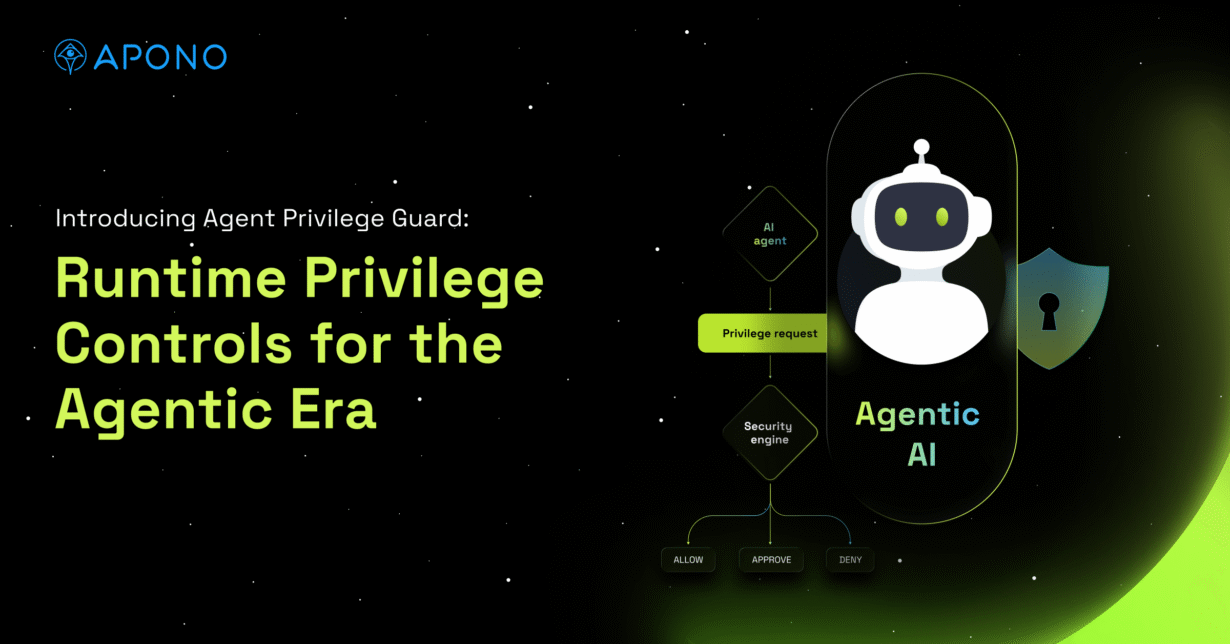
At the core of Agent Privilege Guard is Apono’s Intent-Based Access Controls (IBAC), a runtime enforcement model built around a simple principle: evaluate every privilege request at the moment it is made, based on what the agent is actually trying to do and the sensitivity of the privilege being requested.
Every request falls into one of three outcomes:
- Freely permitted. Low-sensitivity requests are auto-approved instantly, with no friction to agent productivity.
- Human in the loop. Sensitive operations are routed to a human for approval in Slack before execution.
- Denied. Requests that exceed policy thresholds are blocked before they run. The action never executes.
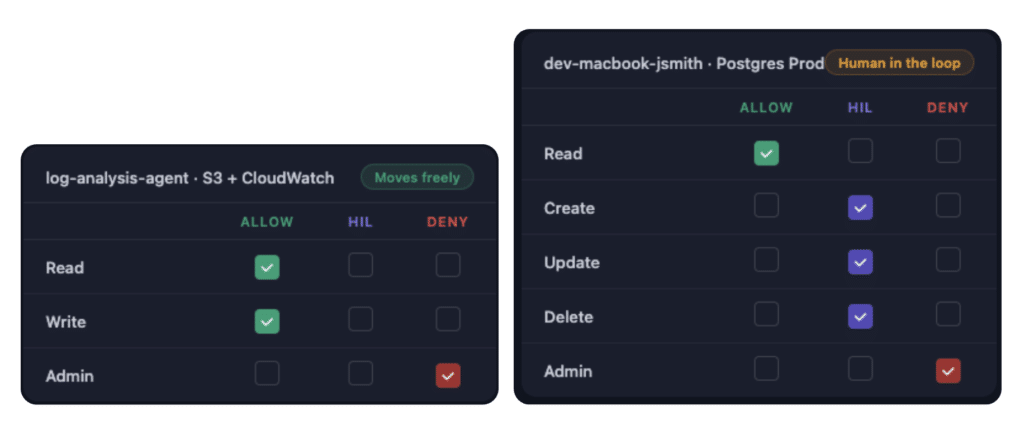
All credentials are ephemeral, scoped to the specific task, and automatically revoked on completion.
Every privilege request, stated intent, approval decision, and downstream action is logged in one place.
After each operation, every environment returns to a state of Zero Standing Privileges. This means that the blast radius of any failure, whether from manipulation, hallucination, or misconfiguration, is contained by design.
This is what Gartner and independent analysts have begun calling Continuous Adaptive Trust: every privilege request assessed at the moment it is made, with privileges revocable in real time if behavior deviates from intent.
Where Zero Trust redefined network security, Continuous Adaptive Trust applies the same logic to identity in the agentic era.
Securing co-pilots today, ready for autonomous agents tomorrow
Most enterprises are already in the early stages of their agentic journey, deploying co-pilots to accelerate engineering productivity.
Agent Privilege Guard secures that deployment today, extending existing just-in-time and just-enough-access policies to co-pilot agents with no additional configuration required.
The privilege gap most enterprises have with their co-pilots can be closed immediately, without rethinking an existing security posture.
As organizations move toward more autonomous deployments, the same platform scales with them.
The IBAC guardrails and audit trail that secure co-pilots today are built to handle fully autonomous agents operating at machine speed, applying consistent runtime privilege controls across every identity regardless of how autonomous it becomes.
The window to get ahead of this is closing
Autonomous agents are moving into production environments faster than security teams can assess the risk. Agent Privilege Guard gives security and IT leaders a way to say yes to agent deployments without writing a blank check on privilege. Agents get the access they need, sensitive operations stay under human control, and every action is logged with full context.
Amazon called its December outage a user access control issue, not an AI issue. They were right. The access controls are the problem, and fixing them before agents are deeply embedded in your infrastructure is significantly easier than fixing them after.
Apono will be showcasing Agent Privilege Guard at RSA Conference 2026 in San Francisco at booth 5170, North Expo.
To learn more or request a demo for Agent Privilege Guard, visit HERE