Just-in-Time Access Policy Design for Cloud Security Teams

Gabriel Avner
January 13, 2026

Just-in-Time access is widely accepted as a best practice for reducing standing privilege. The challenge for most organizations is not deciding to use JIT, but designing access policies that actually reduce risk without slowing engineers down. Security teams want tighter controls, stronger auditability, and less standing access. Engineering teams need fast, predictable access to do their work. When approval policies are too rigid, teams get blocked or work around controls. When policies are too loose, risk quietly accumulates.
This guide explains the core challenges of designing effective Just-in-Time access policies, outlines a practical policy framework, and shows how modern automation makes these policies enforceable at scale.
The Challenge of Balancing Security and Productivity
Access management usually breaks down because environments change faster than policies. Cloud environments are exceedingly dynamic and legacy PAM tools designed for the on-prem era simply cannot keep up with the needs of the business or the risks.
Common problems show up quickly:
- Temporary access becomes permanent because no one wants to disrupt workflows
- Manual approvals turn into bottlenecks, especially during incidents
- The same rules are applied to low-risk and high-risk systems
- Access reviews catch issues long after privileges have drifted.
The result is a model that satisfies neither security nor engineering. Just-in-Time access can solve this, but only when policies are intentionally designed around risk and duration.
Why Time-Bound Access Enables Effective Controls
Standing access creates risk because it exists even when it is not needed. Just-in-Time access reduces that risk by ensuring access is granted only for a defined window and removed automatically when the work is complete.
Effective JIT policies follow a few core principles:
- Privileged access expires by default
- Re-access requires a new request
- Duration is enforced automatically
- Approval requirements reflect risk
When duration is enforced consistently, approvals become a supporting control rather than the only line of defense.
Automatic, Self-Serve, and Manual Access Paths
Modern JIT policies should support different access paths based on risk, without forcing everything through the same approval model.
Automatic access
Used for low-risk environments like development and sandbox systems. Access is granted automatically when policy conditions are met, but still expires. This keeps engineers productive while preventing access from lingering.
Self-serve on-demand access
Used for moderately sensitive systems. Users request access when needed. Policies determine whether approval is automatic or conditional. Access is granted Just-in-Time and removed automatically.
Manual approval
Reserved for high-risk systems such as production infrastructure and sensitive data. Requests require explicit approval and are tightly time-bound. This adds friction where it matters most, without making it the default everywhere.
The goal is not to approve everything. The goal is to align access paths with the sensitivity of what is being accessed.
Recommended Just-in-Time Access Policy Framework
The table below summarizes recommended access durations and approval models, based on Apono best-practice guidance.
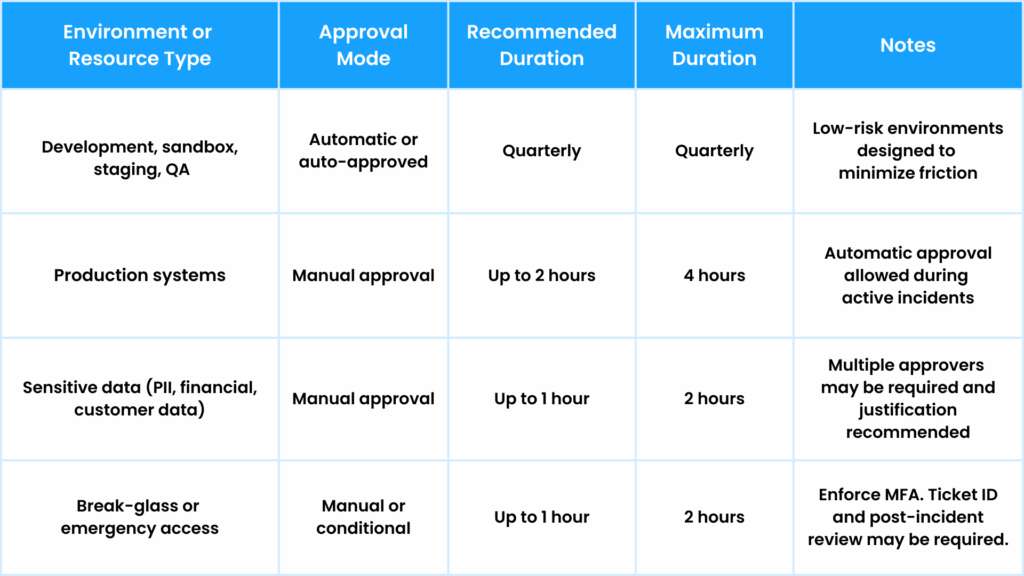
These limits ensure access is time-bound by design and cannot quietly turn into standing privilege.
Using Context to Secure Break-Glass Access
Emergency access presents a unique challenge. During incidents, speed matters, but so does control.
By using context from incident response tools such as PagerDuty, Splunk OnCall, Opsgenie, Grafana IRM, or others, organizations can allow break-glass access only when an active incident exists or when an engineer is on call. Elevated access is granted temporarily, tightly scoped, and removed automatically when the incident ends.
This approach enables fast response without relying on permanent admin access or broad emergency roles.
Enforcing JIT Policies Automatically With Apono
Policy design only works when enforcement is consistent and low effort.
Apono enforces JIT access policies directly in the access flow. Every request includes a required duration. Access expires automatically and must be re-requested if needed again.
Instead of relying on pre-created roles, Apono dynamically creates ephemeral roles on the fly based on the specific resource, and context. Permissions are assembled Just-in-Time, scoped Just-Enough, and removed when access expires.
This approach reduces overprivilege, eliminates role sprawl, and significantly lowers the operational burden on admins. Security teams define policy once, and Apono handles provisioning, expiration, and cleanup automatically.
All requests, approvals, role creation, and expirations are logged by default, creating a clear audit trail without manual evidence collection.
How JIT Policies Support Compliance and Audits
Well-designed JIT access policies directly support common regulatory requirements by enforcing least privilege and accountability continuously.
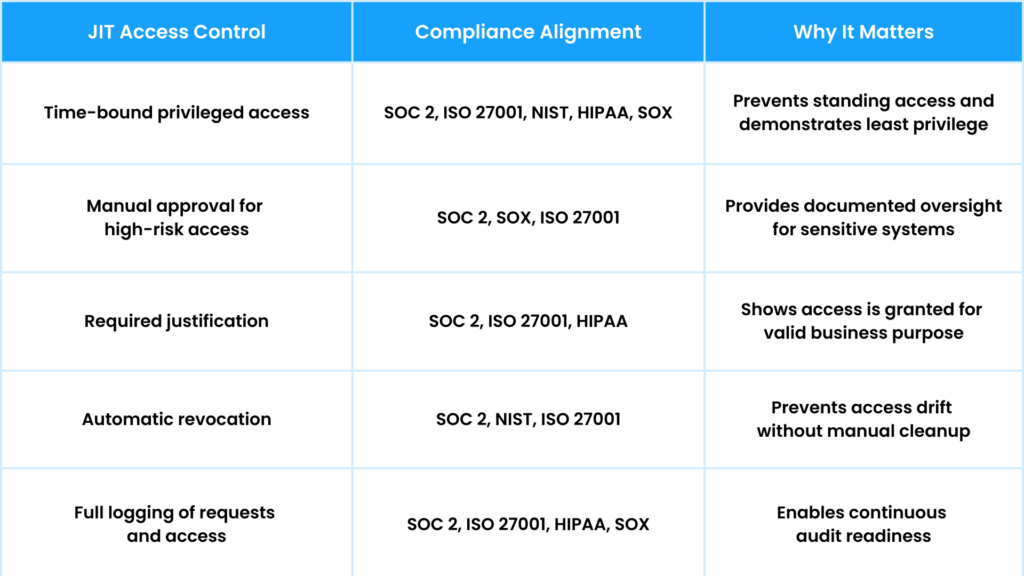
For auditors, this provides clear evidence of who accessed what, why, and for how long. For security teams, it turns compliance into an ongoing control rather than an annual scramble.
Designing Policies That Scale
Strong JIT access policies are not about adding friction. They are about removing standing access while preserving productivity.
By combining enforced expiration, dynamic role creation, risk-aligned approvals, and contextual controls, organizations can reduce privilege exposure, simplify audits, and give engineers the access they need without overprovisioning.
This framework provides a practical starting point for designing JIT access policies that scale with modern cloud environments.
Turn JIT Policy Design Into Enforced Access
You’ve seen how effective Just-in-Time access policies are designed—time-bound access, risk-aligned approvals, and automatic expiration.
The next step is turning those policies into something that actually works in production.
Download The Security Leader’s Guide to Rolling Out Just-in-Time Access to see how security teams operationalize JIT policies across cloud, databases, Kubernetes, and CI/CD—without disrupting engineering workflows.
Or, if you’re ready to see how this works in practice, book a demo to explore how Apono enforces JIT access with dynamic permissions, automatic revocation, and full auditability.