Vulnerability Assessments in an Agentic World: Step-by-Step Guide

The Apono Team
September 8, 2026
Abstract
- An agentic vulnerability assessment evaluates how an AI agent’s identities, permissions, tools, data sources, and actions combine to create risk.
- Effective assessments must trace complete action chains, verify effective permissions, and identify where manipulated inputs can cross trust boundaries.
- Findings should be prioritized using factors such as autonomy, privilege, reversibility, propagation potential, human oversight, and blast radius.
- Remediation requires least-agency design, task-scoped access, approval controls, and continuous retesting as models, tools, integrations, and permissions change.
An old package or a misconfigured cloud storage bucket can be identified by a legacy scanner, but it does not account for the unique risk profile of autonomous systems. It cannot confirm that an AI agent with access to your production environment can chain together a CRM read, an email send and a production write using inherited credentials.
Your agents are dynamic: they plan, call tools, and act across multiple environments, and some may retain context or long-term memory beyond the original request. Conventional security tools can identify software flaws, misconfigurations, and component-level risks, but they may not evaluate the full chain of intent, identity, tool use, and action.
87% of companies identified AI-related vulnerabilities as the fastest-growing cyber risk over 2025. Meanwhile, 64% said their organizations had processes in place to assess the security of AI tools. Without such governance, you are vulnerable to sophisticated threats that circumvent conventional software controls, including identity and privilege abuse, tool misuse, and goal hijacking.
This guide explores the transition from traditional vulnerability management to agentic security. By drawing on the OWASP Top 10 for Agentic Applications 2026, this article outlines a repeatable seven-step process to find, prioritize, remediate, and continuously retest your agentic attack surface.
What makes an AI agent vulnerability assessment different?
Traditional vulnerability assessments identify and prioritize weaknesses in code, configurations, and systems. Agentic assessments extend that analysis to the agent’s observable decision-making and execution workflow.
Rather than focusing only on individual software flaws, agentic assessments also look for logic flaws and permission gaps across the workflow, specifically how an agent reasons, selects tools, manages identity, passes through approval flows, and performs downstream actions.
The primary objective of this evaluation is to understand the agent’s interaction model. Agents do not follow pre-written scripts but create dynamic paths to reach goals. This can create emergent failure modes or vulnerabilities: behaviors that were not explicitly programmed but arise from the interaction of model capabilities, tools, permissions, data, and prompts.
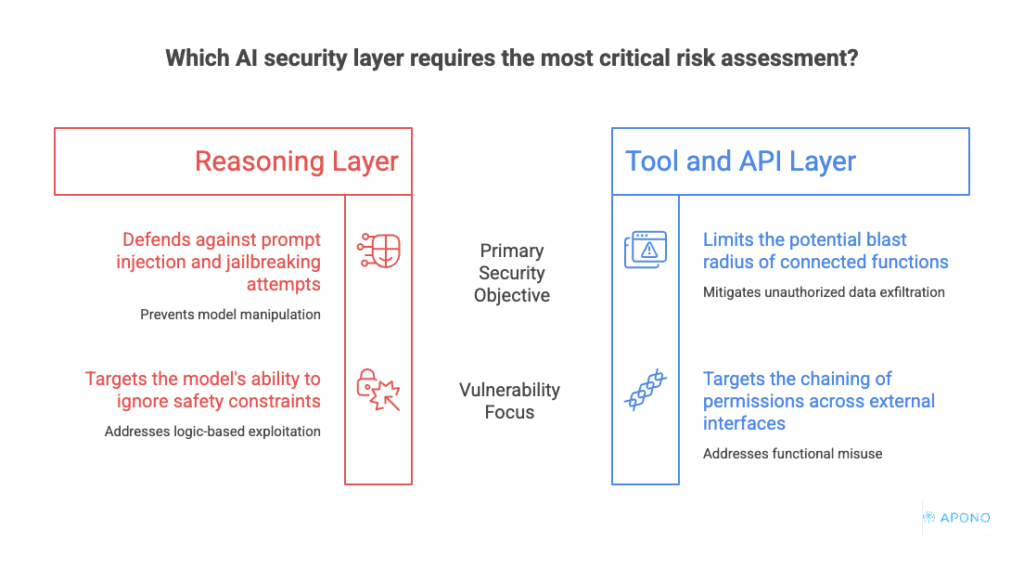
A vulnerability assessment here requires analyzing the interplay between four critical layers:
- The reasoning layer: Testing for prompt injection and jailbreaking that forces the model to ignore safety constraints or misinterpret user goals.
- The tool and API layer: Examining the blast radius of every connected tool. If an agent has access to a tool capable of reading customer data and another capable of sending emails, the assessment must determine if the agent can chain these to exfiltrate data without triggering alerts.
- The identity and privilege layer: Reviewing how the agent inherits credentials. This includes documenting whether the agent operates with standing access, uses long-lived API keys, or requires specific, just-in-time permissions for every distinct action.
- The memory and data layer: Assessing the security of the Retrieval-Augmented Generation (RAG) pipeline. This involves checking whether an agent can be manipulated to leak sensitive indexed or connected data or to consume poisoned information via context manipulation.
Vulnerability Assessment vs Penetration Test vs Risk Assessment
A vulnerability assessment identifies and evaluates weaknesses. A penetration test attempts to exploit weaknesses under defined constraints. Finally, a risk assessment evaluates relevant threat scenarios based on likelihood, impact, and existing controls.
Conventional vs Agentic Vulnerability Assessments
| Assessment area | Conventional assessment | Agentic assessment |
| Primary focus | Individual software components and configurations | Complete chains of prompts, decisions, identity use, tool calls, and downstream actions |
| Behavior | Focuses primarily on defined components, configurations, and known execution surfaces | Must also account for dynamic planning, tool selection, and multi-step actions |
| Identity | Human, application, or service identity | Agent-owned, delegated human, service, or workload identity |
| Permissions | Assigned roles and permissions | Effective permissions across connected tools and environments |
| Data | Application inputs and stored data | Prompts, RAG stores, memory, tool outputs, and connected data |
| Main concern | A software flaw or insecure configuration | A logic flaw, permission gap, or manipulated action chain |
Why Action Chains and Authority Matter
The fundamental shift is from analysis of software components to analysis of chains of actions.
A traditional assessment may stop at an insecure component or configuration. An agentic assessment must also establish which identity the agent uses, what effective permissions it holds, how it combines tools, and what final action it can perform.
Ultimately, the assessment maps the entire action chain. It identifies where an agent might exceed its authority or act on manipulated instructions. An agentic system relies on a sequence of individually valid components, such as a user prompt, an API call, and a database query, so vulnerabilities often reside in the gaps between them. Securing these workflows requires verifying that each step, from initial input to final execution, remains within strictly defined trust boundaries.
You are no longer assessing the vulnerability of a single piece of software. You are assessing the trust boundaries of an autonomous system. You must search for ways an agent can traverse trust boundaries, pivoting from a low-privilege environment to a high-privilege one, or how it can be tricked into using a tool in a way that violates your security posture.
Vulnerability Assessments: Step-by-Step Guide
STEP 1: Define scope, business impact, and rules of engagement
Start by identifying which agents interact with critical systems and assessing their business impact. Some agents matter more than others. An agent that deals with workplace leave requests will have a different risk profile from one that can change cloud infrastructure.
Ensure that you clearly define the rules of engagement so your assessment doesn’t inadvertently destroy production environments. Specify the approved testing environment, prohibited actions, stop conditions, rollback procedures, and emergency contacts.
STEP 2: Inventory agents, identities, tools, data, and privileges
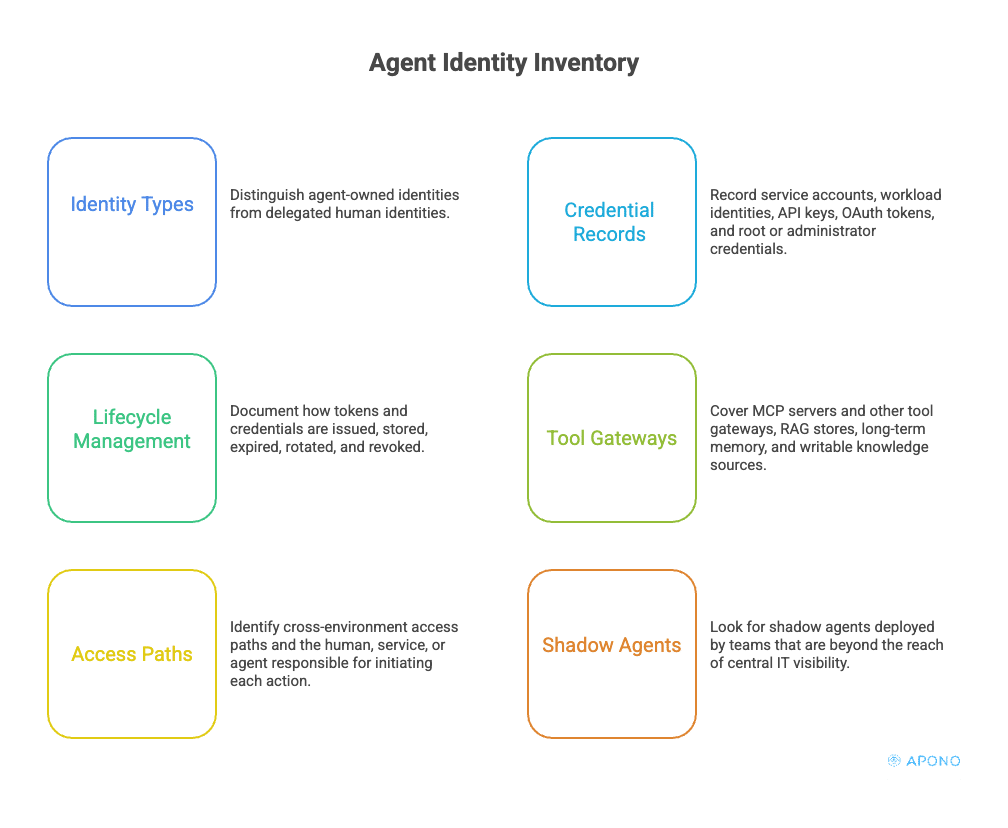
Inventory all agent identities. Identify the tools they connect to, the data sources they pull from, and the downstream dependencies they rely on. Distinguish agent-owned identities from delegated human identities. Record service accounts, workload identities, API keys, OAuth tokens, and root or administrator credentials. Document how tokens and credentials are issued, stored, expired, rotated, and revoked.
The inventory should also cover MCP servers and other tool gateways, RAG stores, long-term memory, writable knowledge sources, cross-environment access paths, and the human, service, or agent responsible for initiating each action. Look for shadow agents deployed by teams that are beyond the reach of central IT visibility.
STEP 3: Threat-model trust boundaries and action chains
Visualize the path an agent follows. What tools does an agent call when it gets a prompt? Does it use a fixed service account, or does it inherit the user’s credentials? Locate the precise action chains where an agent might be able to move from a read-only data source to an administrative write action. Include agent-to-agent messages, delegated tasks, fallback tools, retries, and points where the output of one tool becomes the input for another.
Ask whether low-trust content, such as a ticket description, email, web page, or retrieved document, can influence a high-privilege action.
STEP 4: Test each layer with configuration checks and adversarial scenarios
Move beyond static code scanning. Test the configuration of your agents and the APIs they call, and run adversarial scenarios such as prompt injection to circumvent guardrails or to evaluate whether an agent can be forced to access data it is not supposed to see.
Check how the agent handles untrusted input paths and whether it validates tool outputs before acting on them. Use frameworks such as the OWASP AI Agent Security Cheat Sheet, OWASP’s agentic security guidance, and MITRE ATLAS to organize the tests.
For example, test whether an indirect prompt hidden in a support ticket can instruct the agent to retrieve customer data and send it through an approved email tool. You should also test whether an agent can combine a read-only discovery tool with inherited credentials and a deployment tool to make an unauthorized production change.
STEP 5: Score findings by exploitability, autonomy, privilege, and blast radius
Rate your findings based on the agent’s level of autonomy, its privilege levels, the potential blast radius of an exploit and the business impact of a compromised agent. A high-autonomy agent with write access to production databases should receive immediate remediation priority, while a low-autonomy agent limited to non-sensitive logs may warrant a lower rating.
Also consider reversibility, propagation potential, human oversight, data sensitivity, and detectability. These should be treated as agentic risk modifiers within your existing vulnerability-management process, not as a replacement for CVSS.
OWASP is developing an AI Vulnerability Scoring System (AIVSS), but its current public version is identified as v0.8. It should therefore be treated as an emerging methodology rather than a settled industry standard.
STEP 6: Remediate with least agency and runtime privilege controls
Apply the principle of least agency: give an agent only the tools, autonomy, and action authority it needs to complete its assigned task. Remove unnecessary tools, separate read and write actions, and require approval for sensitive or destructive operations. Then reduce the privileges available to the agent at runtime.
Because privileges are dynamically created at runtime, agents and engineering teams can complete approved tasks without relying on standing access, while reducing dependence on repetitive manual provisioning.
Apono Agent Privilege Guard applies Zero Standing Privilege controls to agents and copilots. It dynamically creates just-in-time and just-enough privileges at runtime rather than relying on pre-provisioned roles or standing credentials.
With Apono, you can evaluate declared intent against requested privileges and actual actions, require human approval when sensitive operations exceed policy thresholds, and log access requests, approval decisions, tools used, and downstream actions.
STEP 7: Retest, monitor, and make assessment continuous
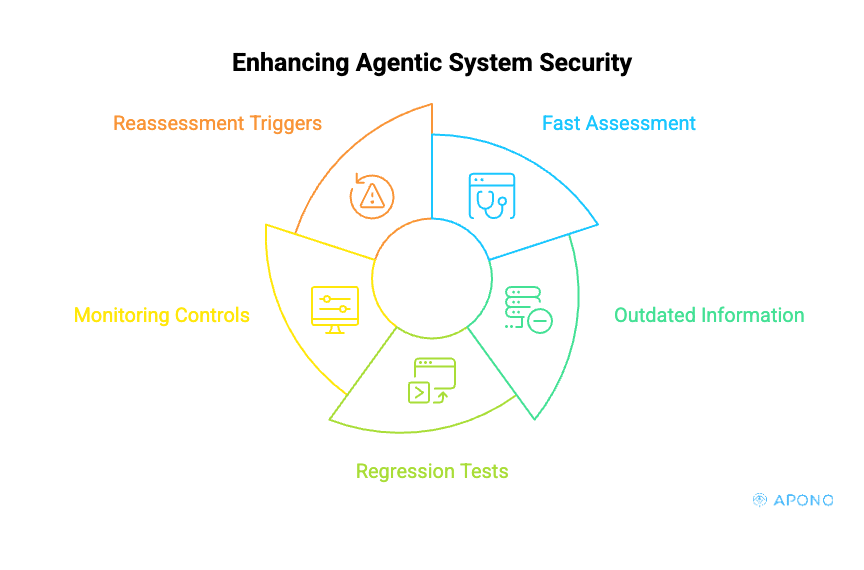
Agentic systems are fast, and a snapshot assessment provides a point-in-time view that can quickly become outdated.
Turn your findings into ongoing regression tests and build monitoring controls to detect drift from your secure baseline. Trigger reassessment when a new model or tool is introduced, an MCP server changes, the agent receives new permissions, a writable data source is connected, or a workflow becomes more autonomous.
Agentic Vulnerability Assessment Checklist
Use the following table to track your progress through the assessment. This checklist ensures your agentic security program accounts for the unique vectors of autonomy and privilege that standard software assessments often overlook.
| Category | Action Item |
| Ownership | Assign a dedicated owner accountable for the agent’s lifecycle, specifically overseeing reasoning paths, tool usage patterns, and update management. |
| Inventory | Build a dynamic registry that indexes all agents, their specific toolsets, data sensitivity levels, and downstream API or platform dependencies. |
| Verification | Perform effective permission mapping by calculating what the agent can actually do versus what it is assigned to do to identify IAM policy gaps. |
| Credential Lifecycle | Enforce strict expiration policies, automated rotation, and centralized credential storage with immediate kill-switch revocation capabilities. |
| Input Security | Establish a threat-modeling framework for all input vectors, specifically testing RAG databases for data poisoning and sensitive leakage. |
| Tool Integrity | Implement a zero-trust approach for tool outputs and cross-agent messages by validating all return values before executing subsequent actions. |
| Adversarial Testing | Conduct Red Team exercises focused on prompt injection, goal hijacking, and chained-tool privilege escalation scenarios. |
| Actionable Scoring | Utilize a standardized risk matrix to score findings based on agent autonomy, privilege levels, reversibility, propagation potential, and business impact. |
| Ephemeral Privileges | Transition away from standing access by implementing Just-in-Time (JIT) provisioning that scopes privileges strictly to the duration of the task. |
| Human-in-the-Loop | Enforce runtime policy checks that pause execution to require explicit human sign-off for high-risk actions (e.g., data deletion or destructive API calls). |
| Attribution | Maintain immutable audit logs that map every action back to the specific initiating entity, whether a human, a service account, or an autonomous agent. |
| Continuous Improvement | Integrate assessment findings directly into your CI/CD pipeline to automate regression testing and establish real-time monitoring of agent behavior. |
| Remediation Validation | Retest every remediation to confirm that the original action chain is blocked without disrupting legitimate workflows. |
Moving from Assessment to Enforceable Control
Agentic vulnerability assessments must follow the full path from input and intent to identity, privilege, tool use, and action. The goal is not only to identify weaknesses, but to reduce the authority and blast radius available if an agent is manipulated, compromised, or behaves unexpectedly.
Apono helps teams turn assessment findings into enforceable access controls. It eliminates standing privileges, creates just-in-time and just-enough access at runtime, applies context-aware guardrails, and requires human approval for sensitive actions. Apono complements code scanning, model evaluation, penetration testing, and red teaming by continuously enforcing identity and privilege controls across agentic workflows.
See how Apono applies Zero Standing Privilege and runtime authorization to AI agents and copilots. Book a live demo.