What is Runtime Authorization? A Use Case-Based Guide

The Apono Team
August 19, 2026
Abstract
- Runtime authorization determines whether an identity can perform a specific action by evaluating the current context at the point of access.
- It supports least privilege and Zero Standing Privilege by replacing broad, persistent permissions with task-scoped access that reflects current risk and business need.
- A policy engine produces the authorization verdict, while enforcement mechanisms apply it through approval requirements, session restrictions, blocking, or temporary permissions.
- This model is especially valuable for eliminating standing privileges, break-glass workflows, risk-based access enforcement, tool and API invocation control, audit and governance, and intent-aware access.
Static roles work until the environment changes. Authentication can confirm who or what is making a request, but it cannot determine whether that identity should perform a specific action under current conditions. As infrastructure, services, and AI agents evolve, permissions granted months ago rarely reflect what an identity actually needs to accomplish.
Among companies planning to deploy agentic AI within two years, only 21% report having a mature model for agent governance. Without a modern approach, security teams remain stuck managing roles that grow more permissive, rather than more precise, as systems scale.
Runtime authorization changes this dynamic by moving the decision point to the moment an action is attempted. It evaluates the current identity, resource, action, environment, and business context before permitting or denying access. This article explains how this shift enables stronger security without compromising operational speed.
What is runtime authorization?
Runtime authorization is the process of evaluating an access request when an identity attempts to perform an action. Its defining characteristic is that the decision uses the current context rather than relying only on permissions assigned in advance.
Runtime authorization is the decision process, while dynamic privilege creation is one possible way to enforce that decision. A runtime authorization system may allow or deny an action directly, require step-up authentication or human approval, add conditions to the request, or create temporary permissions or credentials.
When using runtime authorisation, the system acts as a gatekeeper, not just checking a database of existing roles. It takes a multi-dimensional set of variables and makes a judgment. The resulting decision could allow or deny the action, require secondary authentication, request human approval, impose additional conditions, or create temporary credentials that expire when the task is complete.
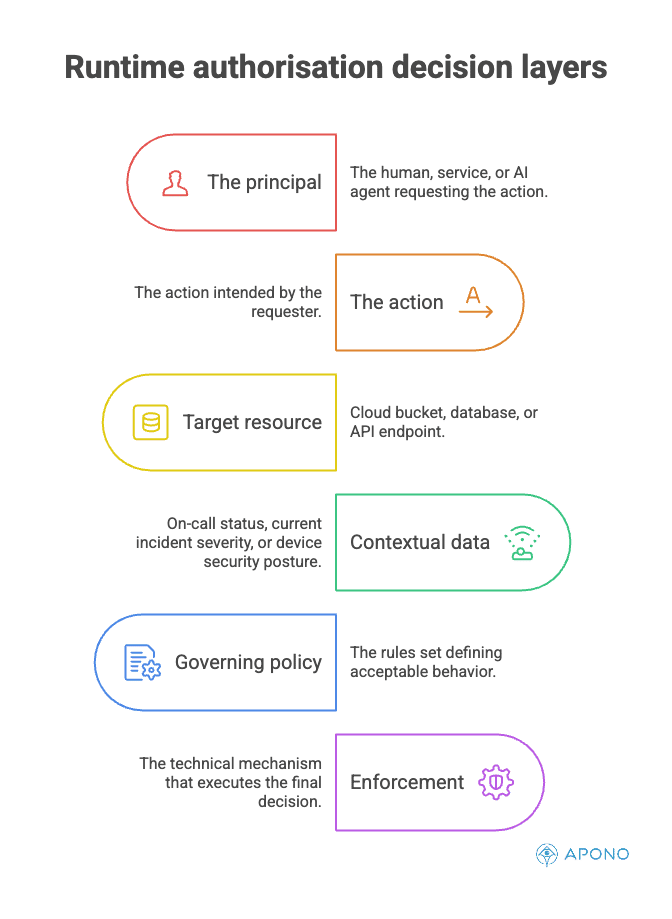
For a sophisticated runtime authorisation decision, there are a few critical layers:
- The principal (the human, service, or AI agent requesting the action).
- The action intended by the requester.
- The target resource (cloud bucket, database, or API endpoint).
- Contextual data (on-call status, current incident severity, or device security posture).
- Governing policy (the rules set defining acceptable behavior).
- Enforcement (the technical mechanism that executes the final decision).
This model does not require the system to recalculate permissions from scratch every millisecond. Instead, it evaluates access at meaningful decision points, such as when a request begins, a sensitive action is attempted, or relevant conditions change.
This architecture proves vital for cloud-native infrastructure, where system states change constantly. It is most relevant when access needs vary by task, environment, resource sensitivity, risk, or identity type. It may provide less value for low-risk, highly predictable systems where simple preassigned roles already provide appropriate control.
Runtime Authorization vs. Authentication vs Preassigned Access vs Just-in-Time Access
| Concept | Core Purpose | Operational Function | Ideal Use Case | When to Avoid |
| Authentication | Identity Validation | Verifies “who” is present using MFA/SSO protocols. | Standard initial system entry and user logins. | Never; it is the non-negotiable security baseline. |
| Preassigned Access | Operational Efficiency | Maps permanent, static roles to groups/individuals. | Stable, low-risk environments with predictable patterns. | High-risk production systems where the blast radius is a concern. |
| Just-in-Time (JIT) | Risk Reduction | Elevates privileges for defined, time-bound windows. | Temporary troubleshooting and specific vendor support tasks. | When not to rely on it alone: When time limits are insufficient, and the decision must also consider current risk, task, resource sensitivity, or business context. |
| Runtime Authorization | Dynamic Governance | Perform run-time evaluation of context-based access policies. | Tool and API invocation, AI-agent access, production operations, and other context-sensitive, high-risk workflows. | Static, low-risk environments where simple RBAC suffices. |
How Runtime Authorization Works
A runtime authorization workflow follows a defined sequence so access decisions can be evaluated, enforced, and audited consistently while minimizing unnecessary friction.
- Request Initiation: A user, machine workload or AI agent requests access or attempts a particular action on a protected resource.
- Context Aggregation: The system pulls in current environment variables, such as team membership, incident status, observability tools, and device security posture.
- Policy Decision Point (PDP): The engine compares the requested action and collected context against defined security policies to determine if the request complies with organizational rules.
- Authorization Verdict: The system makes a clear decision, which can be an allow or deny, or a need for further verification or human intervention.
- Policy Enforcement Point (PEP): The system applies the decision at or near the protected resource. Depending on the architecture, it may block an API operation, grant access to a database, create a Kubernetes role binding, issue temporary credentials, impose session restrictions, or require human approval.
- Observability and Re-evaluation: The platform should record the decision, relevant context, enforcement outcome, and resulting access. For longer-lived sessions, it may re-evaluate authorization when material conditions change.
Together, these inputs create business-context guardrails that reflect how the organization actually operates, rather than relying only on static user-to-resource rules.
Benefits of Runtime Authorization
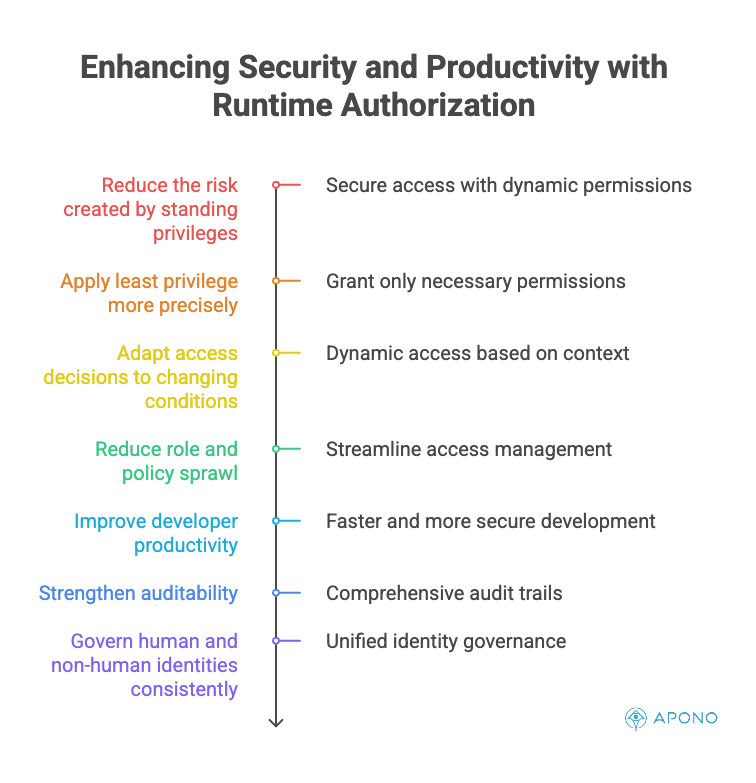
Reduce the risk created by standing privileges
Permanent roles create persistent exposure in modern environments. Runtime authorization can support a Zero Standing Privilege model when it is paired with ephemeral, task-scoped permissions and automatic revocation. This reduces privilege creep and limits the permissions immediately available if an identity, credential, or session is compromised.
Apply least privilege more precisely
Runtime authorization moves beyond binary read or write roles. Hence, it would benefit from least privilege, allowing security teams to scope permissions to the specific context of a task. If an engineer needs to debug a database during an outage, the system grants access only to the necessary tables for the duration of the incident rather than full administrative control.
Adapt access decisions to changing conditions
Static policies can become stale or too broad as identities, resources, and operational conditions change. Runtime authorization allows policies to be context-aware. If a production environment is under attack, the system can automatically elevate the required approval level for any changes, effectively hardening the infrastructure in real time.
Reduce role and policy sprawl
Managing thousands of static IAM roles creates a significant administrative burden and leads to policy bloat. Runtime authorization simplifies this by shifting the focus from managing thousands of specific roles to managing the logic of who can do what under specific conditions.
Improve developer productivity
Developers can lose time waiting for manually reviewed access requests. By automating access decisions and provisioning based on policy, business justification, and current context, teams can provide self-service access without encouraging engineers to bypass security controls.
Strengthen auditability
Access decisions are made at execution time, and the audit trail is much richer. Logs don’t just tell you that someone had admin rights; they tell you exactly why, when and under what conditions that access was granted, which is essential to forensic analysis and compliance.
Govern human and non-human identities consistently
The explosion of AI agents, bots, and machine identities requires a unified governance layer. Runtime authorization applies the same rigorous logic to an AI agent as it does to a human engineer, ensuring that non-human actors are held to the same security standards.
This consistency is increasingly important because non-human identities may operate continuously, use long-lived credentials, and perform actions across several connected systems.
6 Runtime Authorization Use Cases
1. Eliminating standing privileges
Engineers should not have permanent access to production. With runtime authorization, an engineer can request access through a normal workflow while the system checks factors such as team membership, on-call status, an active incident, the target resource, the requested operation, and the required duration.
The system can then issue scoped, time-limited access that automatically expires when the task is complete. With a platform such as Apono, engineers can initiate these requests from the tools they already use, while policy is evaluated and access is dynamically created in the background.
2. Break-glass workflows
Standard approval workflows can slow down incident response. Runtime authorization provides safe break-glass workflows that activate when defined emergency conditions are met, such as an active incident in the company’s ticketing or incident-management system.
A secure break-glass flow should require strong authentication, associate access with an incident ID, restrict the available permissions, enforce a short expiration period, record the resulting activity, and trigger a post-incident review.
3. Risk-based access enforcement
Runtime authorization can differentiate between routine operational activity and higher-risk access to sensitive or regulated data. It can consider factors such as data classification, environment, device security posture, query type, read-versus-write requirements, export volume, and potential blast radius.
Routine read operations may be approved automatically, while bulk exports, destructive commands, or changes to protected production resources can require additional approval or be blocked entirely.
4. Tool and API invocation control
CI/CD pipelines, machine identities, and automated workflows increasingly invoke tools and APIs to perform infrastructure actions. Runtime authorization can evaluate the specific tool, API endpoint, requested operation, target environment, and deployment task before allowing access.
For example, a pipeline may receive temporary credentials only for the environment and deployment operation it needs. The credentials can be revoked immediately after the pipeline finishes, reducing the period during which a stolen credential can be used and preventing access beyond the approved task.
5. Audit and governance
External users, contractors, and third-party services can be difficult to manage and audit through static groups. Runtime authorization can evaluate contract status, internal sponsorship, approved resources, working hours, requested actions, and the intended access period before issuing narrowly scoped access.
It also creates a detailed record of how and why access was granted. Logs can capture the requesting identity, target resource, requested action, contextual inputs, approval decision, resulting permissions, and revocation time, supporting access reviews, investigations, and compliance reporting.
6. Intent-aware access
AI agents and copilots are taking on more complex infrastructure actions. Runtime authorization can compare an agent’s declared intent with the action it is attempting to perform.
An agent assigned to investigate an application outage, for example, may be allowed to retrieve logs and restart a service, but may be prevented from exporting customer data or changing unrelated infrastructure. A robust decision should also account for the agent’s identity, the human or workflow that initiated it, the selected tool, the target resource, and the potential blast radius.
High-risk actions can require human approval before execution, while mismatches between declared intent and actual agent behavior can be denied or escalated.
How to Implement Runtime Authorization
Implementing this model requires a methodical approach to infrastructure and identity security.
- Identify high-risk access paths: Begin locking down production environments, sensitive database functions, cloud admin functions, and AI agent tools.
- Define the authorization request model: Establish clear standards for inputs, including principal identity, requested action, resource target, and business justification. Avoid vague requests such as “production access.”
- Separate policy decisions from enforcement: Keep enforcement as close to the target resource as possible to keep performance, but centralise your policy engine to have consistency.
- Use current, trustworthy context: Rely on authoritative sources for team membership, on-call schedules, and device posture. Outdated data leads to incorrect decisions.
- Default to the minimum required permission: Grant the least privilege required at all times. Enable read instead of write, or single namespace instead of cluster-wide administration.
- Design for latency and availability: This is within the work path, so teams need to define failure behaviors and emergency access procedures.
- Test policies before enforcement: Validate the system with representative cases of conflicting policies or expired approvals prior to production.
- Log and measure authorization outcomes: Track approval times, privilege duration, and false denials to refine policies without weakening security.
A Modern Standard for Access Governance
Authentication is about knowing who is knocking, and runtime authorization is about whether they should be allowed in, based on the state of the world at that moment in time. Static roles remain useful for stable and predictable access, but they cannot account for every change in task, environment, risk, resource, or identity. The strongest architecture combines contextual decisions and enforcement at the protected resource, short-lived permissions, and full audit records.
Apono is a cloud-native privilege access management platform built on Zero Standing Privilege principles. It brings runtime authorization to privileged access across cloud platforms, infrastructure, Kubernetes, databases, and AI-agent workflows. It evaluates access as needed, dynamically creates task-scoped permissions, and revokes them when the work is complete. Security teams reduce standing privilege and role sprawl, while engineers and agents receive access without waiting for repetitive manual provisioning.
See how Apono applies runtime authorization to AI agents with task-scoped privileges, human approval for high-risk actions, and guardrails that reduce standing access. Explore Apono Agent Privilege Guard.