Why DevOps in Cybersecurity SaaS Are Leading the Shift to JIT Access

The Apono Team
July 17, 2025
With automation on the rise and attacks growing more sophisticated, standing access has become a liability. Cybersecurity DevOps teams are showing the rest of the industry how to replace it with smarter, context-aware controls.
DevOps teams are moving faster than ever deploying AI agents, orchestrating automated workflows, and scaling infrastructure across cloud platforms. But as speed increases, so does the attack surface. Traditional access models weren’t built for today’s dynamic, machine-heavy environments, and static privileges have become one of the biggest security liabilities in SaaS.
This blog explores how cybersecurity DevOps teams — often the first to encounter these risks — are leading the shift to Just-in-Time (JIT) and Just-Enough-Privilege (JEP) access. We’ll break down what makes these models effective, how teams are implementing them in the wild, and why vendors like Apono are helping redefine access for the cloud-native era.
Automation: the new risk layer
Engineering teams are deploying more non-human identities than ever before. Scripts, bots, services, pipelines, and more all have high levels of access. While these identities aren’t ephemeral in theory, in practice, their privileges often are: forgotten, inherited, overprovisioned, or simply left standing.
What’s more, in modern cloud environments, non-human identities outnumber humans by a staggering 45 to 1, according to research published in Help Net Security. Yet most of these bots and services are overprivileged – and rarely reviewed.
Security, meanwhile, is playing catch-up
Traditional methods for managing privileged access, like static roles, coarse-grained RBAC, and periodic access reviews, aren’t designed for this dynamic, automated environment. They were built for humans, not machines. They weren’t built for CI/CD pipelines or machine identities that spin up, do their job, and vanish.
And that’s where the risk compounds
According to the 2025 Verizon DBIR, credential abuse is the most common initial attack vector, playing a role in 22% of non-error, non-misuse breaches. Attackers don’t need to break in when their victims leave access standing.
AI is making this situation worse. AI-enhanced phishing and credential stuffing attacks are now good enough to fool even seasoned developers. One token, one unused privilege, one overlooked role is often all it takes.
Why cybersecurity DevOps teams were the first to respond
Security SaaS vendors understand this risk earlier and more acutely than most. Their entire value proposition is trust. A breach isn’t just an incident; it’s an existential threat.
Unlike DevOps teams in general software companies, cybersecurity DevOps teams are exposed to attacker tactics firsthand. They understand the lifecycle of an exploit, they monitor abuse patterns, and they’re often targeted themselves. That proximity gave them a head start.
Forward-thinking DevOps teams at cybersecurity SaaS companies were among the first to respond. With Apono, they’re shifting away from standing access, replacing it with Just-in-Time (JIT) and Just-Enough Privilege (JEP) models that keep security airtight without slowing teams down:
- JIT access determines when access is granted, and for how long. It limits the time window during which elevated privileges exist, thereby shrinking the attack surface and reducing the standing privilege.
- JEP determines what access is granted, based on the specific task and situation. Unlike broad role-based access, JEP utilizes real-time context to apply least privilege principles dynamically.
For Alan Idelson, CISO at Cybereason, these models had a transformative impact on operations:
“Apono allows us to generate temporary permissions upon request on a very granular set of restrictions, delivering huge value to the business by reducing the manual provisioning phase and optimizing the day-to-day work of multiple teams, including the R&D operations and security teams. The product itself is very easy to use from both admin and user side, and it is very flexible.”
Other vendors echo the same story. One AWS Security Architect at a global cyber international firm put it plainly: “Apono was frankly more mature and the superior platform. Within five minutes, I was able to start setting up a Just-in-Time access flow and configure it with its simple user interface.”
These aren’t one-off examples. They show where the industry is headed.
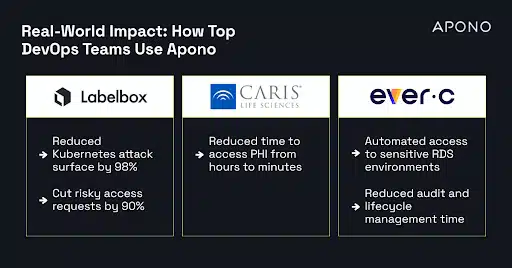
Companies like Labelbox, Caris Life Sciences, and EverC have all used Apono to eliminate standing access, shrink their blast radius, and keep up with the velocity of modern DevOps.
- Labelbox: Reduced its Kubernetes attack surface by 98% and slashed risky access requests by 90%, while accelerating developer workflows.
- Caris: Now grants granular, temporary access to PHI across AWS and on-prem environments in minutes, not hours.
- EverC: Automated access across sensitive RDS environments while minimizing time spent on audits and lifecycle management.
All without slowing development down.
What makes Apono different
We’ve designed Apono to handle the new reality of dynamic infrastructure, fast-moving teams, and connected-cloud environments. Our combined use of JIT & JEP eliminates standing access entirely, whether the identities are human or non-human.
Access is automatically granted and revoked based on policy, risk, and context. It integrates directly with platforms like AWS, GCP, Azure, Slack, Terraform, and Backstage, meaning engineering teams can stay in flow while security teams can stay in control.
There’s no waiting for tickets. No excessive manual reviews. No tradeoff between safety and speed. Instead, there’s control when it matters, for as long as it matters, and no longer than that!
Cybersecurity SaaS DevOps teams have shown the industry how to balance speed with safety. And the rest of the world is catching up.
View our solution brief to see how contextual access, Just-in-Time (JIT), and Just-Enough-Privilege (JEP) can reduce risk, eliminate standing privileges, and boost compliance — all without slowing down your teams. Or dive deeper: Download our security-focused eBook, “The Security Leader’s Guide to Eliminating Standing Access Risk
” to explore the full strategy and implementation insights.