Top 10 Identity Governance Software Solutions

The Apono Team
December 28, 2025
Identity sprawl is exploding. What was once a manageable set of user accounts has rapidly evolved into a complex ecosystem, comprising human identities, service accounts, ephemeral workloads, APIs, and bots, each with its own permissions and potential blast radius.
Machine identities alone now outnumber humans by more than 80:1, creating an ever-expanding attack surface that most teams can’t fully see, let alone govern. 60% of these non-human identities (NHIs) are over-permissioned, turning everyday automation into a ticking time bomb for lateral movement and unauthorized access.
For DevOps and platform teams, the problem isn’t theoretical. You see it every day in the form of outdated service roles that never got cleaned up and bots that no one remembers creating, yet everyone still relies on. Identity governance tools help untangle that mess, providing teams with the visibility and automation they need to maintain secure access.
What are identity governance software solutions?
Identity governance software solutions provide control over who has access to what, and more importantly, why. They add an oversight layer (automated certifications, approval workflows, entitlement management, and privilege drift monitoring) that goes beyond traditional IAM, which manages only authentication and basic roles. IAM identifies users; IGA ensures the continued appropriateness of access.
Identity governance has become critical in cloud-native environments. The old model (static roles and the occasional access review) just can’t keep up with how quickly engineering teams move today. And when accounts in places like CI/CD pipelines start collecting permissions they no longer need, they quietly turn into long-term attack paths if no one is watching.
Identity and access governance is also a core pillar of Zero Trust. If Zero Trust means “never trust, always verify,” IGA is the function that enforces it at the identity layer. Instead of assuming a role is safe because it was approved months ago, modern governance continuously validates that every permission (human and NHIs) is still aligned with least privilege.
The proliferation of NHIs holding long-lived, high-risk permissions that never get reviewed means teams rely on identity governance solutions to discover and right-size these entitlements. And because cloud identities now encompass everything from developers and contractors to service accounts and AI agents, ignoring NHIs is no longer an option.
Benefits of Identity Governance Software Solutions
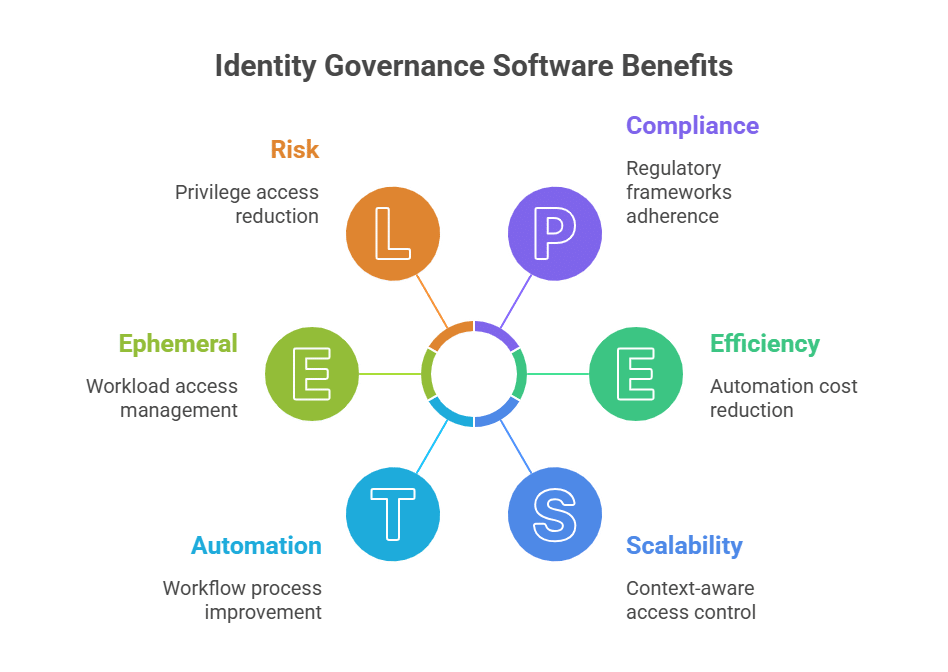
- Reduced risk from excessive privileges: Identity governance solutions proactively detect and right-size over-permissioned accounts to Just Enough Privilege, including NHIs, to reduce lateral movement risk from compromised tokens and long-lived credentials.
- Strengthen compliance and audit readiness: IGA platforms automate access reviews and maintain clean audit logs for regulations and frameworks like SOC 2, HIPAA, GDPR, and CCPA. Instead of manual spreadsheets, you get automated evidence collection and continuous least-privilege enforcement.
- Increase operational efficiency through automation: Workflows, such as provisioning and approvals, are automated, eliminating the ticket load and role sprawl that slow down DevOps teams.
- Enforce scalable, context-aware access: Modern IGA tools apply policies based on identity type, environment, sensitivity, and risk signals for consistent least privilege across multi-cloud and ephemeral workloads.
Key Features of Identity Governance Software Solutions
- NHI visibility and governance: With machine identities far outpacing human users, a modern IGA must discover NHIs and map their access to prevent hidden entitlements.
- Automated provisioning and deprovisioning: The best identity governance software solutions integrate with cloud providers and DevOps tools to ensure identities are created, updated, and removed in real time.
- Just-in-Time (JIT) and time-bound access: A core component of Zero Trust, JIT access enforces least privilege by granting permissions only when needed and automatically revoking them when the task is complete.
- Comprehensive audit trails: IGA solutions provide audit trails for access requests, approvals, and entitlement changes, but not workload-level access logs.
- Seamless cloud and DevOps integrations: Modern stacks span dozens of SaaS apps. A great IGA solution must provide native connectors and APIs to enforce consistent policy across all environments.
- Context-aware access policies: Identity governance should adapt to conditions such as user role and behavioral risk signals, making context-aware policies necessary to enforce granular, dynamic access at scale.
10 Top Identity Governance Software Solutions
Some identity governance software solutions (like Apono) bridge multiple categories by combining traditional governance capabilities with automated, Just-In-Time access and dynamic policies that work across both human and non-human identities. Let’s take a look at the categories.
Category 1: Dynamic Access & Just-in-Time Governance
Tools in this category aim to eliminate always-on permissions by granting people (and systems) only the access they need, exactly when they need it. They’re especially useful for teams working in fast-moving cloud-native security environments where access needs shift constantly.
1. Apono

Apono isn’t a traditional IGA platform; it’s the modern evolution of identity governance built for cloud-native, DevOps-led organizations. Instead of relying on static roles or quarterly reviews, Apono brings Zero Trust to life by granting access only when it’s needed and revoking it immediately afterward. JIT and JEA usually sit in the JIT PAM world, but Apono folds those real-time controls directly into governance.
Designed for fast-moving engineering teams, Apono governs both human users and NHIs, ensuring every request is scoped, time-bound, and aligned with least privilege. Its unified, cloud-native policy plane centralizes access across infrastructure, SaaS apps, databases, CI/CD pipelines, and ephemeral workloads, and is delivered through self-serve Slack, Teams, or CLI workflows without ticketing delays.
Key Features
- Auto-expiring permissions that eliminate standing access risks
- Self-serve, granular access requests via Slack, Teams, or CLI
- Break-glass and on-call flows for rapid incident remediation
- Centralized visibility, access discovery, and audit-ready reporting
Best For: Cloud-native organizations enforcing least privilege, securing NHIs, and automating JIT access.
Price: Contact Apono for customized pricing.
Review: “Quick and easy config to integrate access control with a myriad of service providers and data stores. For administrators, it’s relatively straightforward to define and implement access flows. For the requester, all they have to do is ask for it via Slack, and they get what they need within seconds. Apono keeps track of everything and reacts just in time to apply, restore, or revoke credentials and permissions.”
Category 2: Enterprise-Grade Identity Governance Platforms
Enterprise-grade IGA platforms provide the broad, centralized governance capabilities large organizations rely on to manage tens of thousands of identities. They’re well-suited for companies with established IAM programs and complex approval workflows.
2. Omada Identity

Omada is a comprehensive IGA platform focusing heavily on lifecycle management and policy-driven governance. It is known for its mature workflows and robust audit capabilities, and it integrates with complex IT and HR systems.
Key Features
- Role lifecycle management and policy-based access control
- Automated access certifications and entitlement reviews
- Segregation of Duties (SoD) policy modeling
Best For: Enterprises with complex IAM programs requiring Segregation of Duties (SoD) controls.
Price: By inquiry.
Review: “I like how easy it is to look up and change permissions for a user, and to designate auto-approve for certain things.”
3. Saviynt

Saviynt blends identity governance, privileged access management (PAM), and application access management into a single solution. Users choose it for SoD controls across enterprise apps like SAP and Salesforce.
Key Features
- Cloud-native architecture with strong SaaS integrations
- Risk-based access recommendations and remediation
- Automated provisioning with HR-driven workflows
Best For: Large enterprises requiring unified IGA and PAM.
Price: By inquiry.
Review: “The customer relations have been great, there is a great community, and the tool itself makes it easy to get a return on investment quickly.”
4. CyberArk Modern IGA
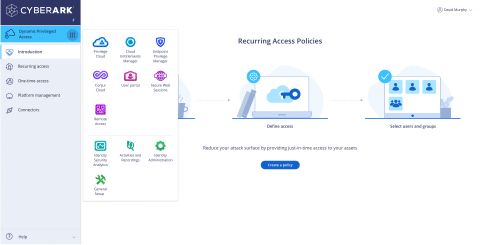
CyberArk’s Modern IGA extends the company’s suite of privileged access security into full identity governance. Built to complement PAM capabilities, it emphasizes lifecycle automation and certification workflows to reduce the impact of credential attacks.
Key Features
- Access certification workflows and entitlement cleanup
- Risk analytics to surface toxic combinations of access
- Native ties to CyberArk’s PAM platform for end-to-end privilege protection
Best For: Organizations already using CyberArk PAM.
Price: By inquiry.
Review: “I like the way we can securely connect to the servers and perform the activity without worrying about cyberattacks or security threats.”
Category 3: Cloud-Native Identity & Access Automation
Cloud-native identity and access automation tools eliminate the manual friction of managing entitlements across distributed, multi-cloud environments. They excel at automating provisioning and identifying privilege drift.
5. SecurEnds

SecurEnds is a cloud-native governance tool designed to streamline access reviews and entitlement cleanup. It’s especially helpful for teams buried in compliance tasks, giving them a clearer view of who has access to what across both SaaS apps and internal systems.
Key Features
- ML-driven entitlement discovery to detect privilege creep
- Risk scoring for accounts and entitlements
- Integrations with HRIS and major cloud/SaaS providers
Best For: Teams needing automated access reviews without deploying a heavyweight enterprise IGA suite.
Price: By inquiry.
Review: “This tool provides a modular approach that can grow and mature along with the organization, ultimately providing automation options for access reviews.”
6. Veza

Veza is an authorization platform that unifies identity-to-data permissions across multi-cloud and SaaS environments. Veza’s graph-based model gives granular visibility ideal for cloud security and data governance teams.
Key Features
- Authorization graph modeling for identity-to-resource mapping
- Domain-specific governance for data stores and cloud IAM
- Alerts for privilege escalations or high-risk entitlements
Best For: Security and data governance teams requiring granular, identity-to-data permissions visibility.
Price: By inquiry.
Review: “Veza Digital delivered items on time and achieved every milestone as planned. They listened to and addressed feedback in a detail-oriented manner.”
7. Elimity
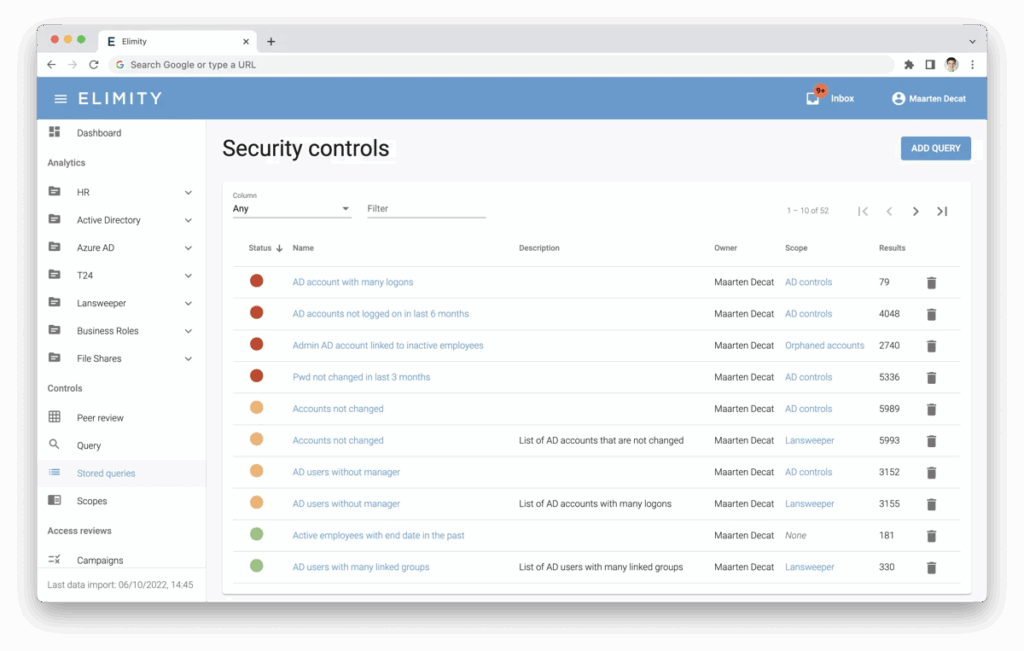
Elimity provides entitlement intelligence and access cleanup insight, making it a strong fit for teams that want improved visibility without deploying a full-scale IGA suite.
Key Features
- Automated entitlement discovery and insights
- Identity risk scoring and privilege anomaly detection
- Integrations with major directory services and SaaS apps
Best For: Organizations seeking lightweight identity analytics and entitlement intelligence.
Price: By inquiry.
Category 4: Policy-Orchestration & Cloud Privilege Platforms
Policy orchestration and cloud privilege tools are all about bringing order to multi-cloud chaos. They pull identity and access rules into one place, smoothing out the differences between platforms so teams can enforce least-privilege consistently across every cloud and application.
8. Strata Identity

Strata Identity’s “identity fabric” approach abstracts away platform-specific policy differences, enabling organizations to enforce consistent access rules without re-architecting infrastructure.
Key Features
- Policy orchestration across multiple IDPs (Okta, Azure AD, Ping, etc.)
- Real-time policy replication and drift prevention
- No-code migration of identity policies between platforms
Best For: Multi-IDP or multi-cloud environments that need to unify and orchestrate identity policies.
Price: By inquiry.
Review: “Strata helped us update the authentication experience and unify SSO without slowing down innovation.”
9. ZertID
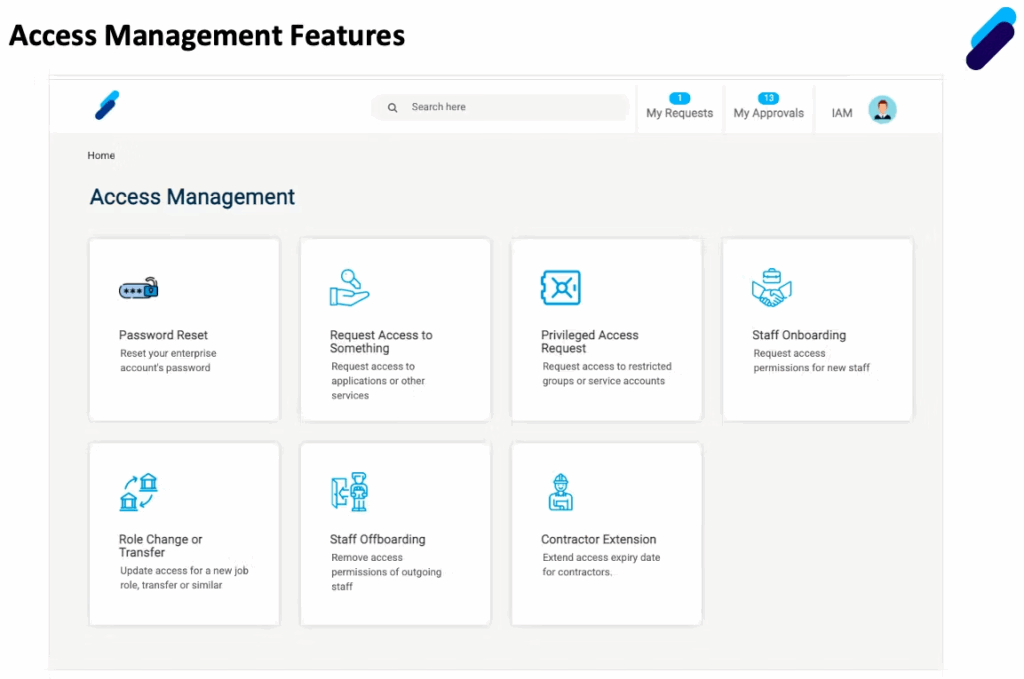
ZertID focuses on cloud entitlement management and identity governance across AWS, Azure, and GCP. It’s used for unifying cloud IAM policies and making cloud permissions easier for security teams to visualize and control.
Key Features
- Permission graphing and entitlement visualization
- Anomaly detection for privilege changes or drift
- Automated cleanup recommendations for excessive permissions
Best For: Cloud-forward teams that need clear visualization and centralized control of AWS, Azure, and GCP IAM entitlements.
Price: By inquiry.
Review: “Zertid helped us to create workflows for integrating and cross-wiring things across the ServiceNow platform and our custom ServiceNow apps.”
10. Britive
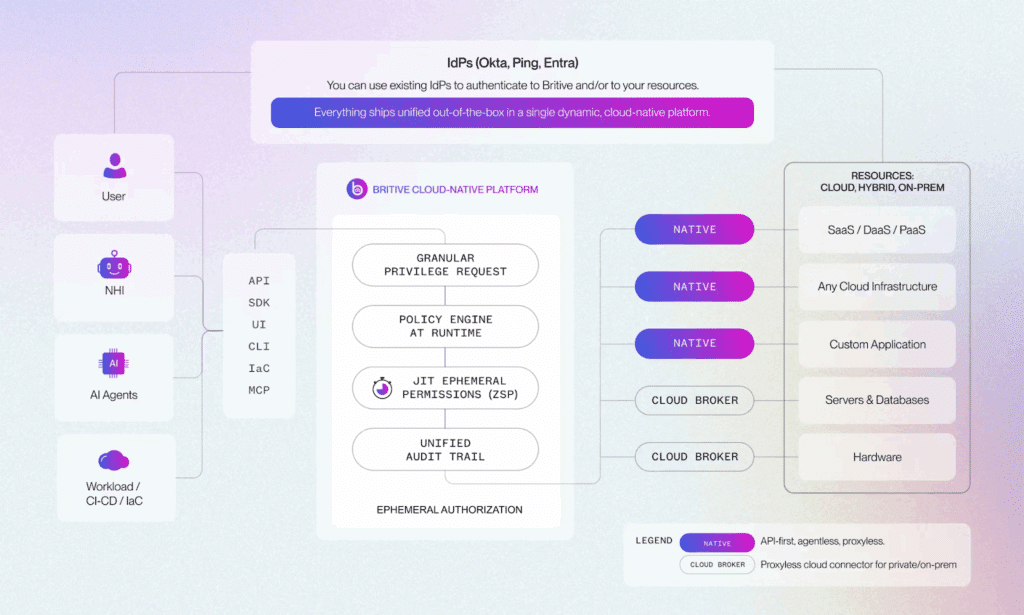
Britive provides a cloud-native privileged access platform designed to automate ephemeral access across cloud and DevOps environments. Focused heavily on CI/CD pipelines and cloud service entitlements, Britive helps reduce standing privileges across cloud and SaaS systems.
Key Features
- Real-time discovery of cloud entitlements
- Context-aware access workflows and policy enforcement
- Integrations with GitHub, GitLab, Terraform, and more
Best For: DevOps and cloud security teams requiring ephemeral access to APIs.
Price: By inquiry.
Review: “Solid product, great team behind it, easy to navigate portal, and comprehensive documentation regarding implementation.”
Reimagining Identity Governance for Modern Cloud Environments
Traditional IAM tools, which rely on static roles and manual approvals, can’t keep pace with cloud-native development or the scale of human and non-human identities that organizations manage.
Apono sits at the center of this evolution. By automating JIT access and enforcing least privilege across both human users and NHIs, Apono bridges the gap between identity governance and real-world DevOps workflows.
With auto-expiring access, centralized audit logs, and one-click self-serve requests via Slack, Teams, or CLI, engineering teams stay productive while security teams regain control and visibility.
If you’re ready to reduce identity-based risk and simplify compliance, now is the time to explore a modern approach to identity management. To dive deeper into how privileged access fits into this shift, check out our PAM Buyer Guide and book a quick meeting with our team to see how JIT access can work in your environment.