Top 17 Agentic AI Security Solutions

The Apono Team
August 6, 2026
Abstract
Agentic AI security solutions help teams discover, govern, monitor, and control AI agents, copilots, LLM apps, MCP servers, and autonomous workflows. For security and DevOps leaders, they matter because agents can act across production systems. This guide compares leading tools and explains how to choose the right fit.
AI agents are moving from assistants to actors. They can query databases, call APIs, trigger workflows, and operate across SaaS apps, cloud infrastructure, Kubernetes, CI/CD pipelines, and internal tools.
McKinsey’s 2025 global AI survey found that 23% of respondents say their organizations are already scaling agentic AI somewhere in the enterprise, while another 39% are experimenting with AI agents.
That shift makes agentic AI security bigger than prompt protection. You need runtime monitoring, identity governance, privilege control, SaaS visibility, MCP/tool-use security, human approvals, and audit trails. The challenge is enforcing those controls without turning every agent workflow into another access ticket or approval queue.
What are agentic AI security solutions?
Agentic AI security solutions help organizations secure the systems that can act on behalf of users, teams, or automated workflows. That includes AI agents, copilots, LLM apps, MCP servers, and autonomous workflows, along with the identities and privileges those systems rely on.
These tools matter because agents don’t just generate responses. They can query databases, call APIs, update records, trigger workflows, and interact with SaaS apps, cloud infrastructure, Kubernetes, CI/CD pipelines, and internal tools. Once agents can take action across real systems, security teams need visibility and control over both agent behavior and agent access.
Traditional AI security controls don’t cover the full risk. Prompt injection, jailbreaks, and data leakage still matter, but agentic AI also creates access and governance problems: excessive permissions, stale tokens, unmanaged service accounts, unclear human ownership, weak audit trails, and agents acting beyond their intended task.
That’s why this category often spans runtime protection, AI risk management, SaaS governance, non-human identity security, MCP and API controls, least-privilege access, human approvals, and just-in-time or task-scoped privileges.
Top Picks at a Glance
- Recommended for AI agent privilege control: Apono
- Recommended for broad AI agent security: Noma Security
- Recommended for prompt injection and GenAI app protection: Lakera
- Recommended for AI SaaS and shadow agent discovery: Wing Security
- Recommended for non-human identity and agent access governance: Astrix Security
Comparison Table: Best Agentic AI Security Solutions Compared
| Tool | Best for | Agentic AI security focus | Key limitation | Setup effort |
| Apono | Agent privilege control | JIT/JEA access, Zero Standing Privileges, runtime privilege creation | Not a replacement for prompt injection, jailbreak, or model-layer runtime security tools | Medium |
| Noma Security | Broad AI security platform | AI SPM, runtime protection, agent governance, MCP security | Broad platform may require cross-team rollout | Medium |
| Lasso Security | Enterprise GenAI visibility and control | AI discovery, usage control, runtime protection | Less focused on infrastructure privileges | Medium |
| HiddenLayer | AI model and app defense | AI discovery, AI runtime security, model threat protection | More AI lifecycle-focused than access-focused | Medium |
| Prisma AIRS | AI runtime security at enterprise scale | AI app, model, and agent protection | Best fit for Palo Alto Networks ecosystems | Medium to high |
| Lakera | Prompt and runtime protection | Prompt injection, jailbreak, data leakage defenses | Not a full identity or privilege platform | Low to medium |
| Entro Security | NHI and AI agent governance | Agentic governance, NHI monitoring, secrets risk | Acquisition status may affect packaging | Medium |
| Teleport | Infrastructure identity and access | Agentic identity, ephemeral access, infrastructure access | Infrastructure-focused | Medium |
| Cato AI Security | SASE-connected AI security | Prompt protection, agent behavior tracing, policy enforcement | Best fit for Cato customers | Medium |
| SentinelOne / Prompt Security | Runtime GenAI protection | AI usage visibility, data leakage prevention, agent protection | Packaging may evolve post-acquisition | Medium |
| WitnessAI | Enterprise AI governance | AI interaction security, agent observability, policy control | Newer category; validate integrations | Medium |
| Pillar Security | Full AI lifecycle security | Discovery, AI SPM, testing, runtime protection | Less focused on identity access management | Medium |
| Reco | SaaS AI agent governance | AI agent inventory, ownership, SaaS access risk | SaaS-focused | Low to medium |
| Wing Security | AI usage and SaaS visibility | AI inventory, behavior analysis, remediation | Less focused on LLM runtime attacks | Low to medium |
| Astrix Security | Agentic and NHI identity security | AI agents, MCP servers, NHIs, static permissions | Acquisition status may affect roadmap | Medium |
| Zenity | AI agent governance across SaaS, cloud, and endpoint | Discovery, posture, runtime detection, prevention | Enterprise rollout may require broad coverage | Medium |
| Aembit | Workload and agent identity access | Agent-to-resource access, MCP gateway, no stored secrets | Less focused on model-layer security | Medium |
Top 17 Agentic AI Security Solutions
1. Apono

Apono, now part of 1Password, is a cloud-native privilege access management platform built on Zero Standing Privilege principles. In an agentic AI security stack, it controls what AI agents, copilots, engineers, and non-human identities can access, why they can access it, and for how long.
Instead of relying on standing privileges or static roles, Apono creates task-scoped access at runtime and revokes it automatically when the work is done. This makes Apono a strong fit for securing agents that need access to cloud infrastructure, databases, Kubernetes, SaaS apps, and internal tools.
Key features:
- Zero Standing Privileges for AI agents
- Just-in-time and just-enough access
- Intent-Based Access Control at runtime
Price: Contact Apono for pricing.
Best for: Cloud-native organizations that need to secure AI agents, copilots, engineers, and non-human identities without slowing production workflows.
2. Noma Security

Noma Security helps teams secure AI models, LLM apps, and agents across discovery, posture management, runtime protection, and governance. It’s a strong fit for organizations that want a broad AI security platform rather than a point solution. Its coverage of MCP server security also makes it relevant as agents rely more heavily on external tools and connected workflows.
Key features:
- AI Security Posture Management
- AI runtime protection
- MCP server security
Price: Contact sales.
Best for: Enterprises that want a comprehensive AI security platform for agents, models, applications, and AI governance.
3. Lasso Security

Lasso Security gives enterprises visibility and control over how employees, applications, and agents use GenAI. It focuses on AI discovery, usage control, runtime protection, and detection and response. Lasso Security is ideal for teams trying to reduce shadow AI risk and enforce policy across enterprise AI adoption.
Key features:
- AI discovery and inventory
- AI usage control
- AI detection and response
Price: Contact sales.
Best for: Security teams that need enterprise-wide GenAI visibility and controls across models, apps, and agents.
4. HiddenLayer
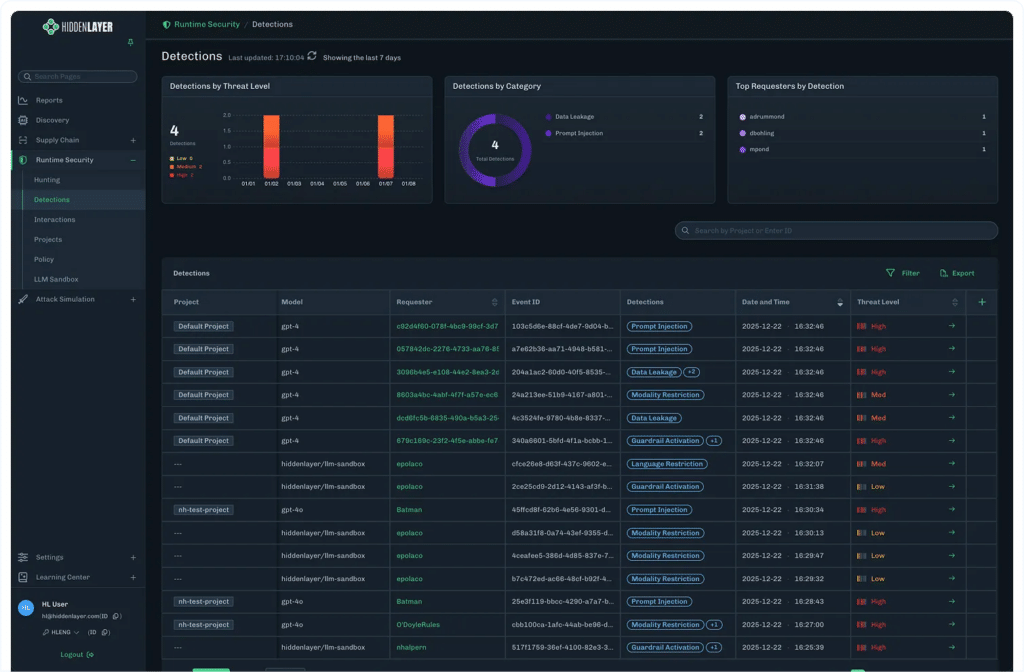
HiddenLayer protects AI models, applications, and agentic systems from AI-specific threats. Its platform focuses on runtime security, AI supply chain defense, and attack simulation. It’s best suited for organizations building or deploying AI systems that need protection across the model lifecycle.
Key features:
- AI runtime security
- AI supply chain security
- AI attack simulation
Price: Contact sales.
Best for: Enterprises securing AI models and AI applications across development, deployment, and runtime.
5. Prisma AIRS
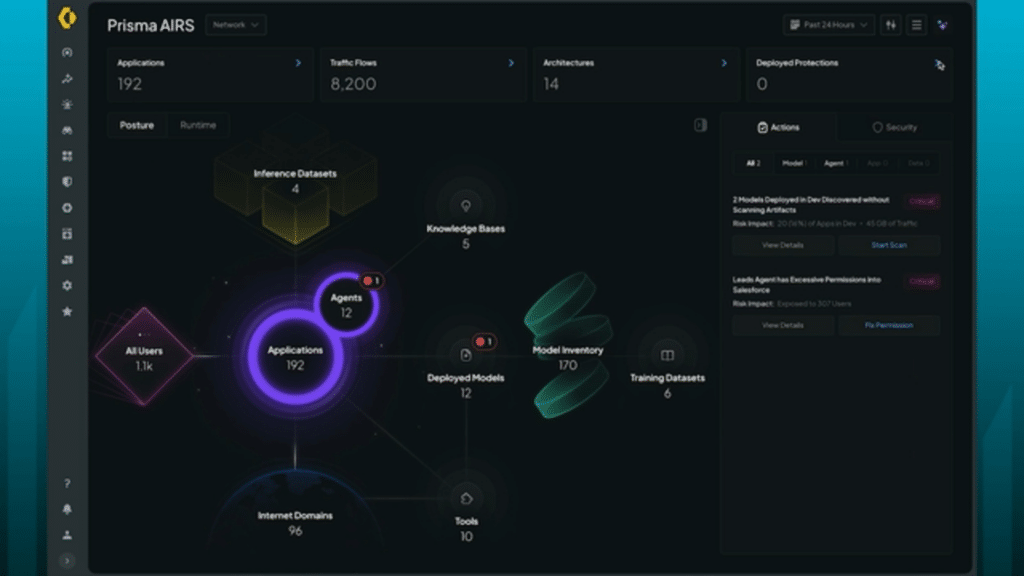
Prisma AIRS is Palo Alto Networks’ AI runtime security platform for securing AI applications, models, and autonomous agents. It monitors prompts, responses, data flows, and agent interactions to detect and block AI-specific threats in real time. It’s a natural fit for large enterprises already using Palo Alto Networks security products.
Key features:
- Prompt, response, and data-flow monitoring
- Agent and plugin interaction security
- Real-time AI threat prevention
Price: Contact sales.
Best for: Large enterprises that want AI runtime security as part of a broader Palo Alto Networks security architecture.
6. Lakera by Check Point

Lakera protects GenAI applications and agents from common LLM security risks like prompt injection, jailbreaks, unsafe outputs, and data leakage. It works well as a runtime security layer for teams building LLM apps, copilots, or AI workflows. Lakera is especially relevant when the biggest risk is malicious or manipulated model interaction rather than infrastructure access.
Key features:
- Prompt attack detection
- Data leakage prevention
- Tool-call and agent workflow screening
Price: Contact sales.
Best for: AI engineering and AppSec teams building LLM apps that need real-time prompt and output protection.
7. Entro Security

Entro Security focuses on securing AI agents, secrets, tokens, and other non-human identities. It helps teams discover agentic identities, understand their access, and detect risky or stale credentials. This makes it a valuable choice for organizations trying to reduce non-human identity sprawl as agents and automations multiply.
Key features:
- AI agent visibility
- Non-human identity security
- Secrets and token risk detection
Price: Contact sales.
Best for: Identity and security teams that need to govern agents, service accounts, secrets, and other non-human identities.
8. Teleport
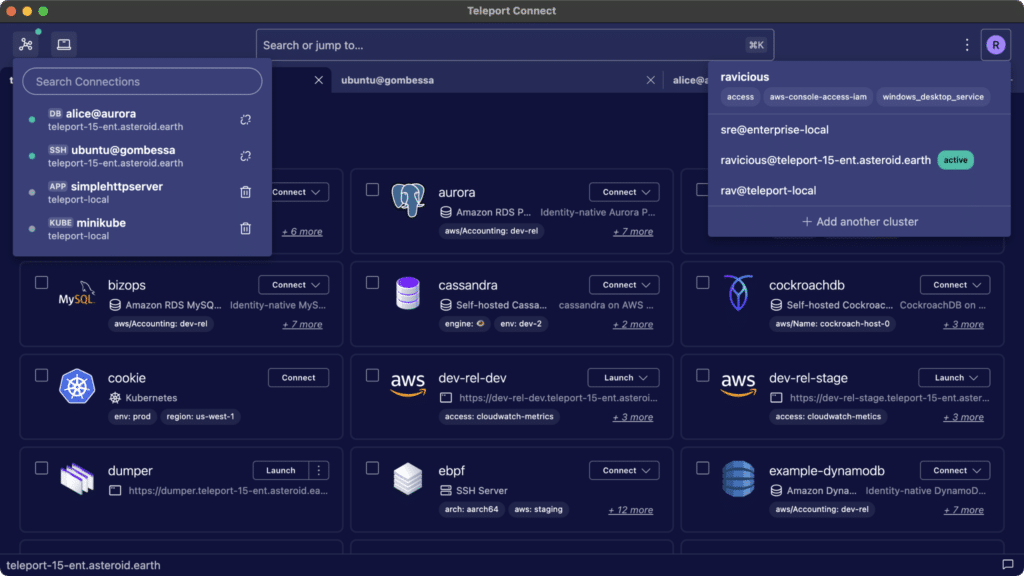
Teleport provides identity-based infrastructure access for humans, machines, workloads, and AI agents. Its agentic AI work includes the Teleport Agentic Identity Framework, plus Beams, an ephemeral runtime for AI agents that is currently positioned around short-lived identities, audit coverage, and secretless infrastructure access. It’s a strong option for platform teams evaluating how agents interact with Kubernetes, SSH, databases, CI/CD systems, and cloud resources, but buyers should validate which agentic capabilities are generally available versus beta.
Key features:
- Agentic Identity Framework
- Beams ephemeral agent runtime
- Delegated Identity and LLM Proxy Capabilities
Price: Public plans are available for some Teleport offerings; enterprise pricing requires sales engagement.
Best for: Infrastructure and platform teams that need identity-based access controls for humans, machines, and AI agents.
9. Cato AI Security
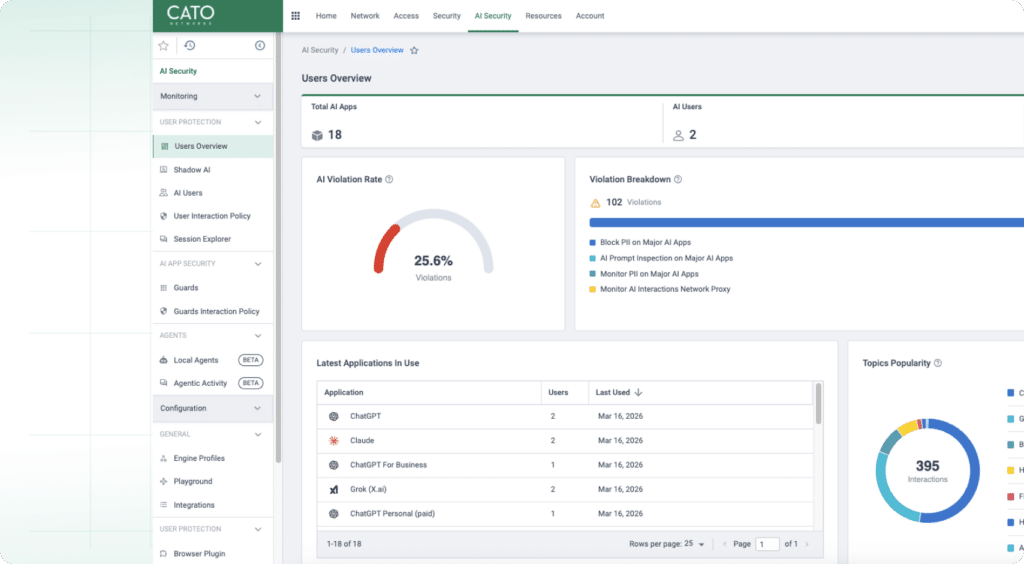
Cato AI Security helps organizations protect AI applications and agentic workflows through Cato’s broader SASE platform. It focuses on prompt injection prevention, jailbreak defense, agent behavior tracing, and policy enforcement before execution. This makes it most relevant for organizations already using or evaluating Cato for network and security convergence.
Key features:
- Prompt injection and jailbreak prevention
- Agent behavior tracing
- Pre-execution policy enforcement
Price: Contact sales.
Best for: Organizations already using or evaluating Cato’s SASE platform and looking to secure AI usage and agentic workflows.
10. SentinelOne / Prompt Security
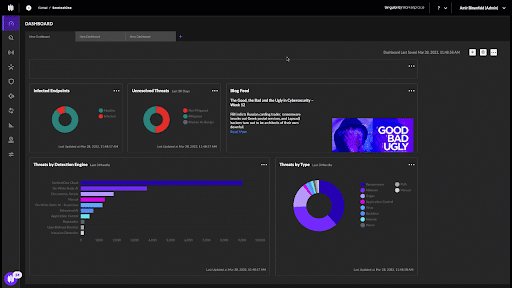
Prompt Security, now part of SentinelOne, focuses on runtime GenAI security. It helps teams monitor enterprise AI use, prevent sensitive data leakage, and protect intelligent agents from unsafe interactions. Buyers should confirm current packaging, since the product may evolve as it becomes part of SentinelOne’s broader platform.
Key features:
- Runtime GenAI security
- AI data leakage prevention
- Intelligent agent protection
Price: Contact sales.
Best for: Organizations standardizing on SentinelOne or looking for runtime controls over enterprise GenAI use.
11. WitnessAI

WitnessAI helps enterprises govern and secure AI interactions across users, applications, models, and agents. Its platform focuses on AI visibility, policy controls, runtime protection, and secure data flows. It’s a good fit for organizations that need centralized oversight of how AI systems interact with sensitive enterprise data.
Key features:
- Network-level AI visibility
- Intent-based controls
- Runtime protection for models, apps, and agents
Price: Contact sales.
Best for: Enterprises that need centralized governance and visibility across AI use, AI agents, and sensitive data flows.
12. Pillar Security
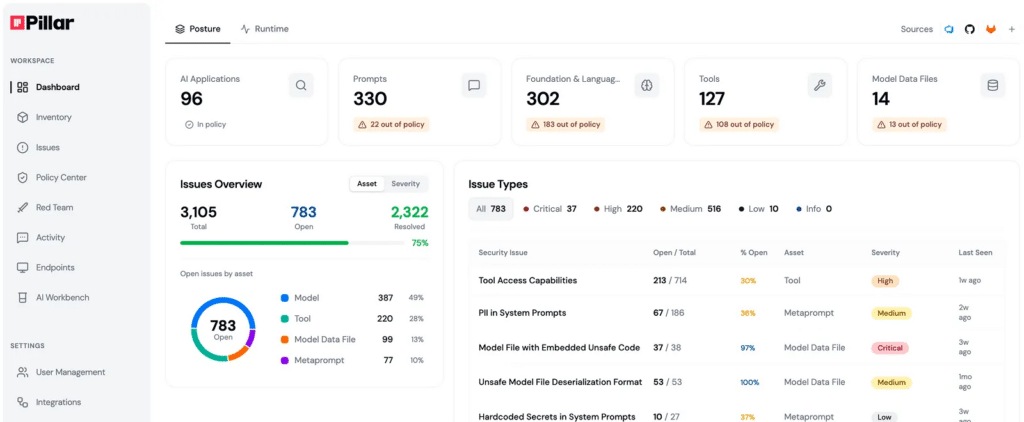
Pillar Security secures AI systems across discovery, testing, and runtime. Its platform combines AI asset visibility, agentic red teaming, posture management, and adaptive runtime guardrails. It’s best suited for teams that want to manage AI risk across the full AI development and deployment lifecycle.
Key features:
- AI agent discovery
- Agentic red teaming
- Adaptive runtime guardrails
Price: Contact sales.
Best for: Security teams that want full-lifecycle AI security across build, test, and runtime.
13. Reco

Reco brings the agentic AI conversation into SaaS security by mapping AI agents, ownership, access, and exposure paths across business apps. This makes it useful for organizations concerned about shadow AI, SaaS sprawl, and agent access to sensitive business data.
Key features:
- AI agent inventory
- Ownership and access visibility
- SaaS AI governance
Price: Contact sales.
Best for: SaaS-heavy organizations that need visibility into AI agents, AI-connected apps, and risky SaaS access paths.
14. Wing Security

Wing Security is strongest in SaaS AI visibility, especially where teams need to uncover shadow AI tools, agents, and over-permissioned app connections. It analyzes AI tools, agents, identities, permissions, and cross-app behavior to identify risky activity. It’s a strong fit for security teams that need visibility into shadow AI and over-permissioned SaaS agents.
Key features:
- AI usage discovery
- Identity behavior analysis
- Over-permissioned agent remediation
Price: Contact sales.
Best for: Security teams that need SaaS AI visibility, agent discovery, and remediation for over-permissioned AI activity.
15. Astrix Security

Astrix Security focuses on securing AI agents, MCP servers, service accounts, tokens, and other non-human identities. It helps teams discover shadow agents, map ownership, monitor non-human identity activity, and understand permission risk across connected systems. This solution is especially relevant for enterprises where agentic AI risk overlaps with NHI security and third-party integrations.
Key features:
- AI agent and MCP inventory
- Shadow agent discovery
- Non-human identity risk context
Price: Contact sales.
Best for: Enterprises that need to secure agentic and non-human identities across SaaS, cloud, and internal systems.
16. Zenity

Zenity provides security and governance for AI agents across SaaS, cloud, endpoint, and low-code environments. It helps teams discover agents, assess posture, detect risky behavior, and enforce controls in real time. This makes it a strong fit for enterprises adopting agents through tools like Copilot Studio, SaaS platforms, and internal automation workflows.
Key features:
- AI agent observability
- AI Security Posture Management
- AI Detection and Response
Price: Contact sales.
Best for: Enterprises adopting AI agents through SaaS, Copilot, low-code, and endpoint-based workflows.
17. Aembit

Aembit supports machine identity management by securing access for AI agents, MCP servers, workloads, and other non-human identities. It acts as an identity and access control layer that lets agents connect to sensitive resources without relying on stored secrets. It’s a good fit for teams that need policy-based agent-to-resource access across cloud, SaaS, and on-prem environments.
Key features:
- Blended Identity for agents and users
- MCP Identity Gateway
- Just-in-time secret delivery
Price: Contact sales.
Best for: Platform and security teams that need to govern how AI agents, workloads, and MCP servers access sensitive resources.
How We Selected These Tools
We compared these tools using publicly available information, including vendor websites, documentation, pricing details where available, product pages, acquisition announcements, and third-party review sources. Because this category is moving quickly, buyers should confirm current packaging, pricing, and roadmap status directly with each vendor.
- AI agent discovery or inventory
- LLM app or agent runtime protection
- Prompt injection, data leakage, or unsafe output prevention
- Agent identity or non-human identity security
- MCP, tool, or API access governance
- Least-privilege, JIT, JEA, or task-scoped access
- Human-in-the-loop approvals for sensitive actions
- Audit trails for agent activity
- SaaS, cloud, or infrastructure access controls for agents
That matters because agentic AI risk spans more than one control layer. A prompt firewall won’t solve overprivileged service accounts. A SaaS discovery tool won’t prevent unsafe tool calls by itself. A privilege platform won’t inspect every prompt. Most organizations will need a layered stack.
Most enterprise teams will need more than one layer because prompt protection, access control, SaaS governance, and auditability solve different parts of the agentic AI risk problem. Look for tools that enforce those controls inside existing developer workflows, so security doesn’t slow incident response or agent-driven automation.
Secure AI Agents by Controlling What They Can Access
Agentic AI security is a stack of controls that protects how agents think and what actions they’re allowed to take.
AI agents, copilots, and human users increasingly operate across the same cloud environments, databases, Kubernetes clusters, SaaS apps, and infrastructure. If those agents inherit standing access, the blast radius grows with every connected system.
Apono belongs in an agentic AI security stack because it focuses on the privilege layer: replacing standing access with task-scoped, time-bound privileges created at runtime and revoked automatically. For teams securing autonomous agents in production, that means agents can move fast without carrying standing admin access everywhere they go.
See how Apono secures agentic AI access with Zero Standing Privileges, task-scoped permissions, and auditable controls for every agent action.