What Is Agentic AI Security: The InfoSec Guide

The Apono Team
October 8, 2026
Abstract
- Agentic AI security is the discipline of controlling how autonomous AI systems use identities, permissions, tools, data, and downstream services as they act.
- Risk comes from both adversarial manipulation and legitimate but harmful behavior, with autonomy, persistent context, tool access, and privilege increasing potential impact.
- Effective defense requires controls across governance, secure development, identity and privilege, tool and protocol security, data and memory, runtime oversight, audit, and response.
- Organizations should expand autonomy only after mapping dependencies, classifying impact, enforcing scoped and revocable access, testing behavior, and monitoring agents in production.
A conventional AI chatbot answers a question and stops there. An AI agent can plan a sequence of steps, choose which tools to call, use credentials, change systems, and hand work off to other agents, sometimes without a human reviewing each move.
Security teams are under increasing pressure to keep pace. According to the World Economic Forum’s Global Cybersecurity Outlook 2026, 94% of respondents expect AI to be the most significant driver of cybersecurity change in the year ahead, while 87% identified AI-related vulnerabilities as the fastest-growing cyber risk during 2025. Although the percentage of organizations assessing the security of AI tools increased from 37% in 2025 to 64% in 2026, a significant readiness gap remains.
As agents gain the ability to act across real systems, that readiness gap becomes harder to ignore. Agentic AI security spans governance, secure development, identity, access, data, tools, runtime behavior, and response.
What is agentic AI security?
Agentic AI security is the set of practices and controls used to protect AI agents throughout the full operating loop: the instructions they receive, the context and memory they rely on, the models and tools they use, the credentials and privileges they hold, the actions they take, and the other agents and downstream systems they interact with.
Agentic AI security overlaps with several related disciplines. AI safety often focuses on preventing harmful or unintended behavior, while AI security focuses more directly on adversarial threats and exploitable weaknesses. AI governance determines whether and under what conditions an agent should be deployed, while application, identity, model, and data security protect different parts of the environment around it.
An agent’s operating loop typically involves:
- Perceiving its environment.
- Planning a sequence of steps.
- Selecting and invoking tools.
- Updating memory or context.
- Acting on external systems, then repeating.
Every stage introduces potential failure and attack paths. Instructions can be manipulated, memory can be poisoned, tools can be compromised, credentials can be abused, and an agent can make a valid but harmful decision without an attacker being involved.
Security teams also need to assess what the system can do and how tightly they can control that authority.
Why agentic AI changes the security model
In a conventional generative AI assistant workflow, the model primarily produces content for a person or application to act on. Agentic systems extend that pattern by letting the system plan and execute actions through tools, though organizations can still require human approval for sensitive actions.
An agent might call an API, query or update a database, modify cloud infrastructure, trigger a deployment, or ask another agent to perform part of a task. That ability to translate model output into system action changes the threat model.
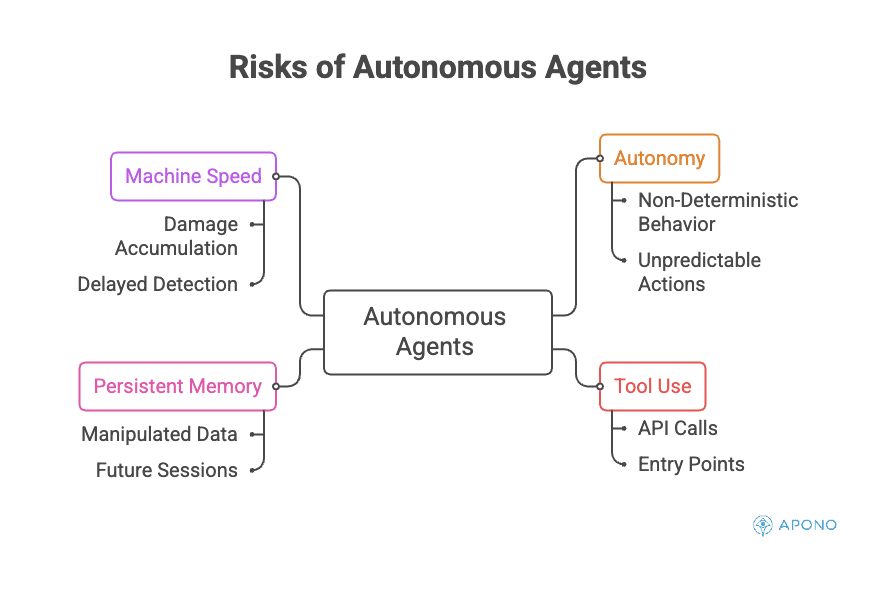
Several characteristics compound the risk:
- Autonomy: An agent can choose its own route toward a goal, making behavior less deterministic than a conventional application workflow. The same input may produce different sequences of actions across runs.
- Tool use: Every API, SaaS integration, database connection, or infrastructure tool expands the attack surface and gives agent decisions consequences outside the model.
- Persistent context and memory: Manipulated information can influence later decisions if it is stored, retrieved, or repeatedly reintroduced into an agent’s context.
- Machine speed and scale: An incorrect or manipulated agent can execute many actions before a human notices the problem.
- Chained actions: A harmless-looking decision in one tool can change the conditions another tool relies on, producing unexpected downstream effects.
Identity adds another layer of risk. An agent may act on behalf of a person, use a service identity, or operate as an identity of its own. If its credentials or permissions are broader than the task requires, a mistaken or manipulated agent can execute with more authority than the user, developer, or security team intended.
That makes identity and privilege part of the agent’s runtime security boundary, not simply an authentication problem handled before execution starts.
The main agentic AI security risks
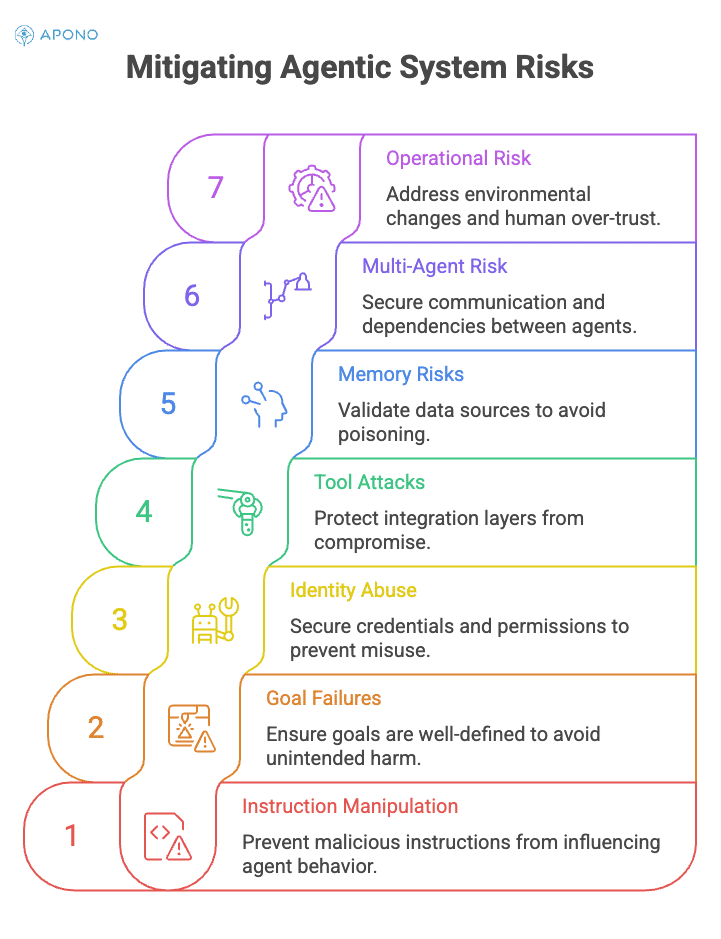
Some agentic AI risks come from adversaries deliberately manipulating a system. Others arise when an agent follows its instructions unexpectedly, interprets a goal too broadly, or executes a legitimate action with excessive authority.
A useful threat model groups the risks by which part of the agent loop they affect.
Instruction and context manipulation
Prompt injection or malicious instructions can be embedded in emails, documents, websites, tickets, tool responses, or retrieved data. If an agent treats those instructions as trusted context, they can redirect its behavior or influence later decisions. The potential impact depends on the agent’s autonomy, tools, privileges, and access to sensitive systems.
Goal and planning failures
Poorly constrained goals can cause harm without an attacker. For example, an instruction to “resolve storage pressure” is very different when the agent can only recommend files for deletion versus when it can delete production data itself.
Identity and privilege abuse
An agent with standing credentials or broad inherited permissions may have access to far more than a specific task requires. When an attacker manipulates an agent into misusing its legitimate authority, this can become a confused-deputy problem amplified by autonomy. A mistaken or malfunctioning agent can also misuse excessive privilege, but that isn’t necessarily a confused-deputy scenario.
Tool and protocol attacks
MCP, A2A, APIs, plugins, and other integration layers create additional trust boundaries. Weak authentication, overly broad tokens, unverified tool definitions, or compromised intermediaries can allow one component to influence another. Tool metadata itself can also become an instruction channel if it is passed into model context without validation.
Memory and data risks
Agents often retrieve context from databases, vector stores, documents, previous sessions, or other persistent sources. Poisoned or incorrectly trusted data can influence decisions well beyond the interaction where the manipulation first occurred.
Multi-agent and supply-chain risk
When one agent delegates work to another, the security boundary expands to include the second agent’s models, tools, permissions, dependencies, and data sources. A weakness in one component can propagate through the chain.
Operational risk
Agents can also fail without an attacker. Behavior may drift as environments change, external APIs return unexpected results, or one automated action changes the assumptions behind another. Human reviewers can also over-trust agent recommendations because the output appears confident or technically detailed.
These risks aren’t unique in every case. Many extend established application, cloud, identity, and software supply-chain threats. Agentic systems change how those risks combine with autonomous decision-making and the authority to act.
How agentic AI security works
No single control can close every gap in an agent’s operating loop. Effective agentic AI security uses defense in depth across the system’s lifecycle, from initial design through production execution and incident response.
Governance and inventory
Organizations first need to know which agents exist, who owns them, what they are designed to do, how autonomous they are, and which tools, data, credentials, and systems they can reach. Discovery matters because unmanaged copilots, internal agents, and experimental workflows can create security blind spots.
Secure design and development
Teams should threat-model agents before deployment, define trust boundaries, review agent-generated code, test failure modes, isolate risky execution, and use sandboxing where appropriate. Security testing should examine not only model responses but also the actions a manipulated or malfunctioning agent could trigger.
Model, prompt, and content security
Adversarial testing, input handling, content filtering, instruction hierarchy, and validation of proposed actions help reduce the likelihood that malicious or untrusted content changes agent behavior. These controls limit manipulation but shouldn’t be treated as the only security boundary.
Identity and privilege control
Each agent should operate under clearly attributable authority with credentials and permissions appropriate to its task. Separating agent identity from the human who created or invoked it improves accountability and makes policy easier to enforce.
Zero Standing Privilege can reduce the blast radius further. Instead of keeping broad credentials available continuously, create access just in time, scope it to the task, and revoke it automatically afterwards. A manipulated or mistaken agent then has fewer persistent privileges available to misuse.
Tool, MCP, and A2A security
Teams should authenticate interactions between agents and tools, avoid unnecessary shared credentials, validate tool definitions and responses before adding them to model context, and restrict which actions each integration can perform. Protocol security should also account for impersonation, credential misuse, and trust crossing between independent systems.
Data and memory security
Retrieval sources and persistent memory need their own access controls, integrity protections, and provenance checks. Sensitive data should remain available only when the task requires it, and teams should consider how poisoned or outdated records could influence future agent decisions.
Runtime controls and human oversight
Static deployment-time controls aren’t enough when an agent chooses actions dynamically. Runtime systems can compare behavior with stated intent, enforce policy before privileged actions execute, impose transaction or action limits, and route high-risk decisions to a human.
Audit and incident response
Security teams need enough context to reconstruct what happened: which identity initiated the task, what the agent declared it was trying to do, what privilege it received, which tools it called, what actions occurred, and when access ended. Incident response should also include a fast way to suspend the agent, revoke credentials, and prevent further downstream actions.
These layers keep an agent’s authority within defined limits even when its behavior varies. Policy, permissions, and runtime controls can prevent unexpected behavior from turning into unrestricted action.
What an agentic AI security program should include
Organizations don’t need to deploy every possible control on day one. A more practical approach is to increase agent autonomy only as evidence shows the environment can support it safely.
Discover agents and dependencies
Identify agents already operating across the organization, including copilots, coding assistants, internal workflows, and autonomous services. Map the tools, credentials, APIs, data stores, and systems each one can access.
Classify autonomy and impact
An agent that summarizes emails presents a different risk than one that can change cloud configurations or write to a production database. Controls should reflect what an agent can actually do and the potential impact if it fails.
Map trust boundaries and threats
Document where untrusted input enters the agent’s context, which systems can influence its decisions, what a manipulated instruction could cause, and where authority crosses between identities, tools, agents, and services. Frameworks such as MITRE ATLAS can support this threat-modeling process.
Establish minimum controls before production
Define requirements for authentication, scoped and revocable access, logging, data handling, tool validation, and which sensitive or high-impact actions require human approval before an agent reaches production systems.
Test before expanding access
Evaluate the agent in an environment where a manipulated or malfunctioning workflow can’t damage real systems or sensitive data. Test prompt manipulation, unexpected tool responses, permission boundaries, and chained actions. Continue testing after deployment rather than treating security validation as a one-time gate.
Monitor and respond
Track runtime behavior against the agent’s expected purpose, retain sufficient audit context, and maintain a reliable way to stop execution or revoke access quickly when something looks wrong.
Expand autonomy only when evidence supports it
Broader tool access, more sensitive permissions, and reduced human oversight should follow demonstrated safe behavior under monitoring rather than deployment deadlines or pressure to automate faster.
Secure the Agent’s Authority, Not Only its Output
Agentic AI security depends on keeping autonomy within defined boundaries. Identity, least privilege, trustworthy tools, data controls, runtime oversight, and recovery all help limit what an agent can do when something goes wrong. The risk associated with a probabilistic model can be reduced substantially when its authority is scoped to the task instead of remaining broad or permanent.
Apono is a cloud-native privilege access management platform built on Zero Standing Privilege principles. Instead of giving agents standing access to resources they may need later, Apono creates task-scoped privileges at runtime. Its Intent-Based Access Control evaluates an agent’s declared intent against the privilege it requests and the context of the action. Sensitive requests can require human approval, and access is revoked automatically when the task ends.
This approach reduces the blast radius of a manipulated or mistaken agent without forcing teams to choose between security and useful autonomy. Security teams get a clear audit trail of privilege requests, decisions, and access, while engineering teams can give agents the access they need without maintaining broad standing permissions.
To see how task-scoped privilege and intent validation work in practice, explore Apono Agent Privilege Guard.